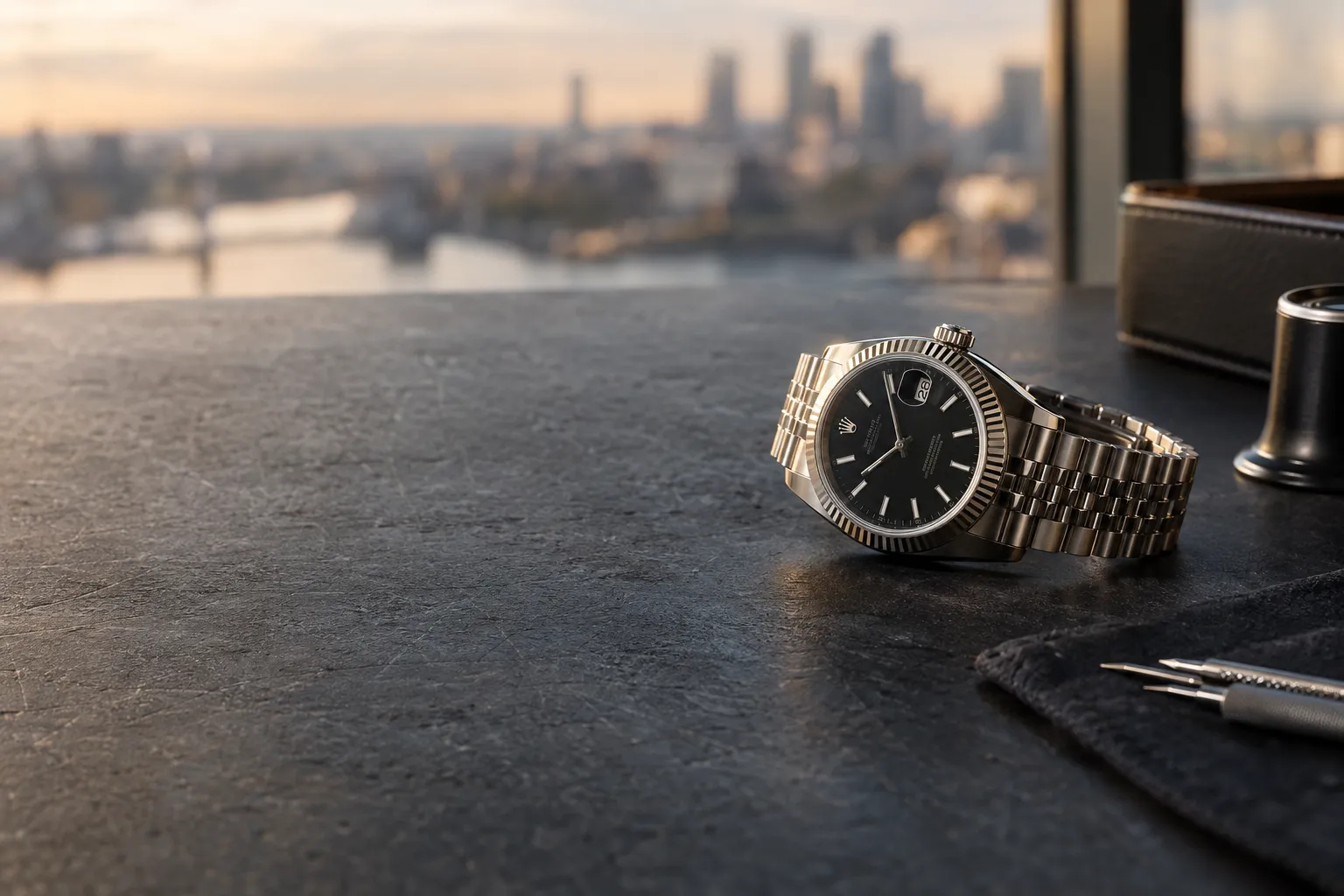
Rolex is a watchmaking name shaped by technical milestones and a collection of distinct designs. This guide explains its history, model families, buying considerations and care advice using official Rolex information.
Rolex is a Swiss watchmaker with a history that includes the Oyster case and the Perpetual rotor.
Its collection is divided broadly into Classic and Professional watches, with models designed around different styles and functions.
Year Hans Wilsdorf established his watch business in London
1905
Year Rolex introduced the Oyster case
1926
Year Rolex introduced the Perpetual rotor
1931
Year Rolex dates the introduction of the Submariner and Explorer
1953
At a glance
Rolex in brief
Rolex is best understood through the relationship between design, function and history. The name spans a broad collection, so knowing the differences between its watch families is more useful than treating every model as interchangeable.
A useful way to approach Rolex
Rolex is a Swiss watchmaker whose name is associated with recognisable wristwatch designs, mechanical watchmaking and a long-running story of technical development. Yet the brand is more than a set of familiar silhouettes. Its collection brings together watches conceived for different settings, from formal daily wear to activities that demand specialised functions. Understanding that variety makes it easier to look beyond the logo and ask the more useful questions: What is the watch designed to do? Which details define its identity? And what should a prospective owner know about purchasing and care?
What this guide covers
This guide follows those questions in sequence. It outlines key historical milestones, explains the broad distinction between the Classic and Professional collections, and considers how a few well-known models developed their identities. It also offers practical guidance on buying, authenticity and ongoing care. The aim is not to rank models or predict market value, but to provide a grounded framework for appreciating Rolex watches on their own terms.
Origins and development
Rolex history: the milestones behind the name
Rolex’s history is most informative when viewed as a sequence of responses to the changing role of the wristwatch. The company’s own timeline records developments in precision, case construction and winding, followed by watch families with clearly defined purposes.
From early wristwatches to a Geneva watchmaker
Rolex traces its origins to 1905, when Hans Wilsdorf established a watch business in London. The company’s official historical account describes an early focus on wristwatches at a time when the pocket watch remained prominent. Wilsdorf pursued compact watches that could be worn on the wrist while maintaining reliable timekeeping. The company later moved its operations to Geneva, where the Rolex name became closely linked to Swiss watchmaking.
Milestones in precision and the Oyster
The company’s history is often presented through developments that shaped the practical wristwatch. In 1910, a Rolex wristwatch received a Swiss certificate of chronometric precision. Rolex identifies the Oyster case, introduced in 1926, as a key step in its work on water resistance. In 1931, it introduced the Perpetual rotor, an automatic winding system that uses the movement of the wearer’s wrist to wind the watch. These milestones connect the brand’s technical story with everyday use: accurate timekeeping, protection of the movement and continued operation while worn.
How model histories took shape
Later model launches made these engineering ideas visible in specific designs. Rolex dates the Datejust to 1945, the Submariner and Explorer to 1953, and the GMT-Master to 1955. Each arrived with a different design problem in view: a calendar display, underwater timekeeping, exploration, or tracking a second time zone. The details and specifications of present-day watches are not identical to those of their early predecessors, but their historical connections help explain why the names remain distinct within the collection.
The collection
How the Rolex collection is organised
The names of Rolex’s watch families offer a practical map of the collection. They indicate broad design traditions, but meaningful comparisons require attention to individual watches and their current specifications.
Classic and Professional
Rolex groups its watches into two broad families: Classic and Professional. This is a helpful starting point, rather than a complete guide to every difference between models. Classic watches tend to foreground versatile styling and everyday wear. Professional watches draw on designs associated with particular activities and functions. The distinction is about a collection’s design language and heritage; it should not be taken as a promise that any watch is suitable for every real-world use.
The Classic collection
The Classic collection includes established names such as Datejust, Day-Date, Oyster Perpetual and 1908. Their designs vary in formality, display and detailing. A Datejust, for example, is recognised for its date display, while the Oyster Perpetual represents a more pared-back expression of the Oyster design. The important point for a reader comparing watches is to examine the particular reference and configuration, not to assume that a family name alone describes every feature.
The Professional collection
The Professional collection includes models such as Submariner, GMT-Master II, Explorer, Sea-Dweller, Yacht-Master and Cosmograph Daytona. Their names and histories suggest different use cases, from diving and travel to exploration and motorsport. These associations help explain the design choices, but current specifications must be checked model by model. Bezel markings, displays, bracelet options, case dimensions and water-resistance ratings can differ between versions and generations.
Compare the watch, not only the name
A thoughtful comparison starts with the way a watch will be worn. Consider how easily its size sits on the wrist, whether the display is legible for your needs, how the bracelet or strap feels, and whether its style works with the clothes and settings you expect. Then compare the exact references. This approach avoids choosing on reputation alone and keeps attention on the qualities that will matter after the first impression.
Distinct model stories
Four Rolex models and the ideas behind them
A model name becomes easier to understand when it is connected to the function and history behind its design. These examples show how different Rolex watches developed distinct identities within one collection.
Datejust: a defining calendar watch
The Datejust’s story begins in 1945. Rolex describes it as the first self-winding waterproof chronometer wristwatch to display the date in a window on the dial. Its date display helped give the model a readily identifiable purpose, while the broader design has been offered in different sizes, materials, dials and bracelet styles over time. For a buyer, this variety makes the exact configuration especially important: two watches sharing the Datejust name can have quite different visual character.
Submariner: purpose behind the design
The Submariner began in 1953 as a divers’ wristwatch. Rolex’s official materials say the original model was waterproof to 100 metres, while the current Submariner is waterproof to 300 metres. Its rotating bezel allows elapsed time to be read, a function associated with its diving origins. The model’s familiar appearance has helped it travel beyond its original context, but buyers should distinguish an aesthetic connection to diving from the technical limits of a specific watch. Always check the rating and instructions for the exact model.
GMT-Master: time across zones
The GMT-Master was introduced in 1955 and is associated with tracking more than one time zone. Its design history reflects the practical problem of reading local time alongside another reference time. The current GMT-Master II is a separate iteration within that family, with its own configuration and instructions. Anyone considering it for travel should learn how the specific model’s hands and bezel operate rather than relying on a general description of the collection.
Explorer and Cosmograph Daytona
The Explorer and Cosmograph Daytona illustrate two further strands of Rolex’s model history. The Explorer is linked to the brand’s exploration narrative, while the Daytona is associated with motorsport timing. Their identities rest on a combination of naming, design and historical context. These associations provide a useful way to understand the models, but they do not establish that one is more suitable or desirable for every wearer. Comfort, legibility and personal preference remain individual considerations.
Before you decide
A practical guide to comparing and buying a Rolex
Choosing a Rolex is a matter of matching a particular watch to your preferences, intended use and budget. A measured process puts the exact configuration and reliable information ahead of assumptions about status or resale.
Start with use and comfort
Begin with the intended role of the watch. A straightforward daily watch, a calendar display, a second-time-zone function and a timing bezel answer different needs. Think about whether you will use a particular feature regularly or simply value its design. This is not a test of technical expertise; it is a way to distinguish practical priorities from the pull of a model’s reputation.
Check the exact configuration
Next, compare the exact watch rather than relying on a broad model name. Rolex’s collection pages provide current official model information. Look at case dimensions, materials, dial, bezel, bracelet and movement details listed for the specific version. If you are considering a pre-owned watch, the reference and condition matter as well. A photograph or a short description may not reveal whether parts have been changed or whether the watch has a documented service history.
Use official sales channels
For a new genuine Rolex watch, Rolex states that sales are made exclusively through Official Rolex Jewelers. The brand also notes that availability can vary. Contacting an Official Rolex Jeweler is therefore the appropriate way to confirm current availability, configuration and purchasing details in your market. Do not treat an online listing, a reseller’s claim or a model’s general popularity as proof of authenticity or availability.
Approach pre-owned watches carefully
For a pre-owned purchase, proceed methodically. Ask for clear information about the watch’s reference, condition, included documentation and service history. Have the watch assessed by an appropriately qualified professional if authenticity or condition is uncertain. Rolex’s own guidance explains its official service process and the role of its network. A seller’s paperwork or presentation may be useful context, but it should not replace a reliable assessment.
Keep price and value in perspective
Finally, set expectations around price and availability without assuming that a quoted price predicts future value. This guide does not make investment claims or provide live market prices. Retail prices, local taxes, availability and pre-owned prices can vary. For current information, check with an Official Rolex Jeweler and compare like-for-like references, taking condition and provenance into account.
Ownership
Caring for a Rolex watch
Responsible care does not require complicated routines. Follow model-specific instructions, avoid treating water-resistance claims as a substitute for condition checks, and turn to professional help when a watch needs attention.
Everyday cleaning and handling
Mechanical watches benefit from sensible daily handling. Rolex advises owners to wind and set a watch according to the instructions for its model and to keep it clean. For an Oyster case, the brand’s care guidance describes rinsing with fresh water when needed, particularly after exposure to salt water, and using a soft cloth. Make sure the crown is secured correctly before contact with water, and follow the instructions specific to the watch rather than applying one model’s procedure to another.
Understand water resistance
Water resistance is not a permanent, context-free guarantee. Seals can be affected by age, use and damage, and a watch should not be exposed to water if its condition is uncertain. Do not operate the winding crown or other controls underwater unless the official instructions for that model specifically allow it. If the watch has been knocked, opened or shows signs of moisture, seek professional advice instead of relying on a visual check.
Servicing and maintenance
Rolex recommends periodic professional servicing, approximately every 10 years depending on the model and real-life use. That is guidance, not a fixed appointment schedule for every watch. Changes in timekeeping, damage, unusual sounds or condensation can be reasons to seek advice sooner. Rolex’s service information explains that watches can be presented through Official Rolex Jewelers and its authorised service network. Ask for current service details and costs directly, as these can depend on the watch and work required.
Records and professional assessment
Keep any records, receipts and service documents associated with the watch in a safe place. They can help establish its maintenance history, although documentation alone cannot guarantee authenticity or condition. If the watch is no longer keeping time as expected, avoid opening the case or attempting repairs yourself. A professional assessment protects the movement from avoidable damage and gives you clearer information about the next steps.
Design and meaning
Why Rolex remains a subject of interest
Rolex sits at the intersection of watchmaking, design and personal symbolism. Understanding those layers can deepen appreciation while keeping the practical realities of ownership in view.
Function and recognisable form
Rolex has achieved a particular balance: its watches are presented as technical instruments, yet many have become enduring elements of personal style. The Oyster case and familiar model outlines give the collection a visual continuity, while differences in display, materials and function allow individual watches to serve different preferences. This continuity is one reason the brand is often discussed through both engineering history and design culture.
Personal meaning and public recognition
The cultural meaning of a Rolex is not fixed. It can be a tool watch, a milestone gift, a family object, a design choice or a symbol of achievement, depending on its wearer and context. Those associations can add to a watch’s appeal, but they can also distract from the questions that matter in ownership: whether it suits the person wearing it, whether its features are useful, and whether it can be cared for appropriately.
Look beyond market narratives
A considered appreciation of Rolex does not need to begin with rarity or resale. It can begin with the way a bezel works, the proportions of a case, the clarity of a dial or the history of a model. Reading official material alongside the watch itself gives context without turning every purchase into a claim about investment. The strongest reason to choose a watch is often the combination of design and function that continues to make sense to its wearer.
A measured conclusion
Rolex is a broad subject, and no single model represents the whole company. Its history, collection structure and ownership guidance offer a more complete picture than a logo alone. Start with the model family that interests you, verify the exact details through official sources, and take time to assess fit, function and care. That approach leaves room for appreciation without confusing brand recognition with a guarantee of suitability, authenticity or future value.
Questions answered
Rolex watches guide FAQs
Where can I buy a new genuine Rolex watch?
Rolex states that new genuine Rolex watches are sold exclusively through Official Rolex Jewelers. Contact one to confirm current availability and details.
How often should a Rolex be serviced?
Rolex recommends periodic professional servicing, approximately every 10 years depending on the model and real-life use. Follow model-specific guidance and seek professional advice if the watch is damaged or not working as expected.
Are all Rolex watches suitable for swimming or diving?
No single general answer applies to every watch or its condition. Check the water-resistance rating and instructions for the exact model, and do not expose a watch to water if its condition is uncertain.
What is the difference between Rolex Classic and Professional watches?
They are two broad collection groupings. Classic models generally emphasise versatile everyday design, while Professional models have design histories associated with particular activities or functions. Compare current specifications model by model.
Does Rolex guarantee that a watch will retain or increase in value?
This guide makes no promise about future value. Prices and availability vary, and resale outcomes depend on factors such as the exact reference and condition.