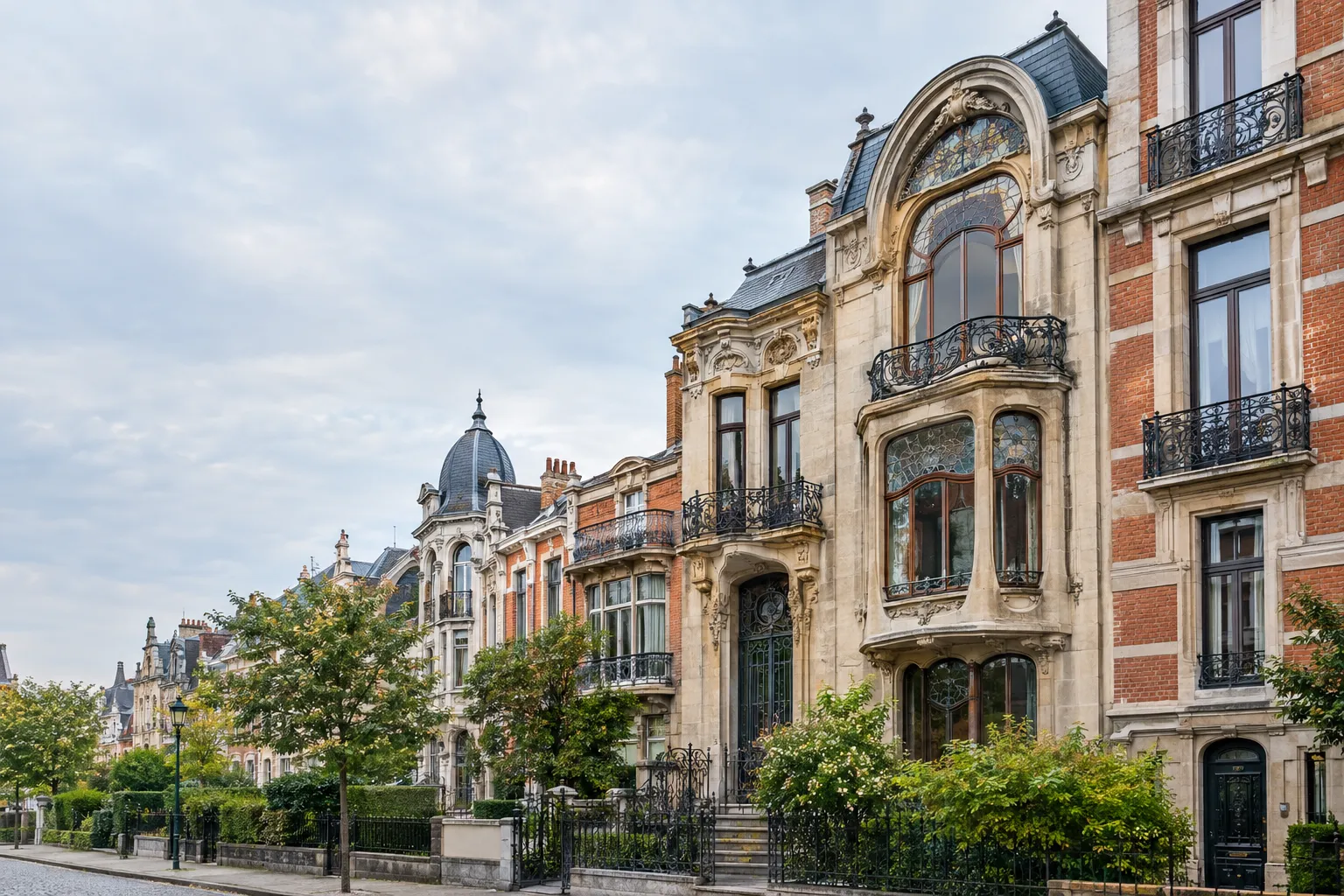
Brussels is best explored with an eye for connection: the façade that frames a street, the interiors where architecture becomes part of daily life, and the objects that bring design down to human scale. A walk through Saint-Gilles, a visit to the Horta Museum and a separate stop at Design Museum Brussels offer three distinct ways to read the city. This considered guide explains what each reveals and how to plan around current official visitor information.
Start with the Visit Brussels Art Nouveau itinerary through Saint-Gilles.
Visit the Horta Museum to consider Victor Horta’s former home and studio, built from 1898 to 1901, as a complete designed interior and exterior experience. Check its visitor guide before travelling.
Construction period of Victor Horta’s former home and studio
1898–1901
Neighbourhood covered by a Visit Brussels Art Nouveau itinerary
Saint-Gilles
Location of Design Museum Brussels
Near the Atomium
Exhibition formats described by Design Museum Brussels
Permanent and temporary
From street to interior
An architecture-and-design itinerary through Brussels
A thoughtful exploration of Brussels moves between the city’s façades, the designed spaces behind them and the objects that shape everyday life. These places offer a grounded way to do that: begin with an Art Nouveau walk through Saint-Gilles, step inside Victor Horta’s former home and studio, then consider a wider design perspective at Design Museum Brussels. Practical arrangements change, so check official visitor information before making a plan.
A city best read at more than one scale
Brussels rewards the visitor who looks beyond the first impression. Its architectural story is not confined to a single landmark or period: streets shift between domestic façades, civic buildings, decorative details and contemporary life. The most absorbing way to explore is to move between the public city and the intimate scale of its interiors, then consider how objects and materials shape everyday surroundings. Art Nouveau is an especially vivid point of entry, but it is not the whole story. A considered visit can begin outdoors in Saint-Gilles, continue through Victor Horta’s former home and studio, and widen into the history of design at Design Museum Brussels. The value lies in seeing these places not as a checklist but as connected evidence of changing ideas about form, craft and urban life.
How to look at Brussels architecture
In Brussels, architecture often becomes most legible when viewed at walking pace. A façade offers the first clues: the rhythm of its openings, the arrangement of balconies, the line of a cornice, or the way decorative work gathers around a doorway. Looking carefully encourages a different kind of sightseeing. Instead of moving quickly from monument to monument, allow a street to reveal repetitions and variations. The broad composition may appear orderly from a distance, while closer inspection brings out the individual decisions made by architects and makers. This approach is particularly rewarding in neighbourhoods associated with Art Nouveau, where architectural design can extend into ironwork, glass and interior decoration. A useful habit is to look both up and down: upper-storey details can be easy to miss, while entrances often contain some of a building’s most expressive work. Keep the visit flexible. A suggested walk can provide direction, but pauses and side streets are part of the experience rather than a distraction from it.
Start with the overall shape of a building, then notice its windows, entrance and decorative materials.
Look for how details relate to the façade as a whole, rather than treating ornament as an isolated flourish.
Allow time for street-level observation and brief pauses, especially in residential neighbourhoods.
Art Nouveau as architecture and interior design
Art Nouveau provides a distinctive lens on Brussels because it brings architecture and applied arts into close conversation. The movement is often recognised through flowing lines and botanical references, yet its significance goes beyond a recognisable visual vocabulary. In a well-conceived interior, the architectural structure, stair, wall surfaces, glazing and decorative elements can work as a continuous composition. That is why a street view alone may only suggest the design logic at work. Visit Brussels’ walking itinerary through Saint-Gilles points visitors towards façades associated with architects including Victor Horta and Ernest Blerot, and notes the importance of interior detail. It also leads towards the Horta Museum. Read the route as an invitation to compare, not as a claim that every building shares the same approach. Differences in proportion, materials and ornament help explain how a style was interpreted across a neighbourhood. The experience is less about identifying a single motif than noticing how the parts of a building contribute to a whole.
Treat decorative detail as part of a building’s overall design, not as an added layer alone.
Compare façades along a walk to see how architects used related ideas differently.
Remember that an exterior view cannot reveal every aspect of a designed interior.
Walking Saint-Gilles with an architectural eye
Saint-Gilles makes a compelling starting point for an architecture-focused day because its streets offer a way to encounter Art Nouveau in the urban fabric. Visit Brussels publishes an itinerary through the area, with façades by architects including Victor Horta and Ernest Blerot, and a route that ends at the Horta Museum. The walk gives the visitor a simple structure: observe buildings in their neighbourhood setting, then move from the public street into a preserved domestic and working environment. That transition matters. A façade presents design to the city; a house reveals how spatial arrangement and decoration can shape daily life. Do not assume that an itinerary guarantees access to every building it mentions. Much of the pleasure of a street-based route comes from what can be appreciated from public space, while museum entry and any interior visits should be checked separately. Plan enough time to look, rather than treating the route as a distance to cover. A slower pace makes architectural relationships easier to notice.
Use the Visit Brussels Saint-Gilles itinerary as a route framework and check its current details before setting out.
Distinguish street viewing from entry to a building; access arrangements can differ.
Keep the walking plan adaptable so that observations and unplanned details have room.
The Horta Museum: a designed home and studio
The Horta Museum offers a more intimate understanding of the relationship between architecture and design. It occupies Victor Horta’s former home and studio, built between 1898 and 1901. Visit Brussels describes mosaics, stained glass and wall decoration among the features of the building. These details are especially useful for understanding why Art Nouveau is often discussed as a complete design approach: the house is not merely a container for decorative objects, but a place in which structure, surfaces and visual details can be considered together. A visit also changes the scale of the architectural experience. Outside, the building belongs to a street; inside, the visitor can pay attention to the sequence and character of rooms, subject to the museum’s visitor arrangements. The official Horta Museum visitor guide is the appropriate place to check practical information before arrival. Do not rely on assumptions about current opening arrangements or access. Those details can change, and a little advance checking makes it easier to focus on the building itself once there.
The Horta Museum was Victor Horta’s former home and studio, built from 1898 to 1901.
Visit Brussels identifies mosaics, stained glass and wall decoration as notable features.
Consult the museum’s own visitor information for current arrangements before visiting.
Design Museum Brussels and the wider design picture
Architecture is only one part of Brussels’ design story. Design Museum Brussels offers a complementary way to think about how designed objects, materials and visual ideas enter daily life. Its location near the Atomium makes it a distinct stop from the Art Nouveau sites in Saint-Gilles, so it is best treated as a separate visit rather than casually folded into a short walking loop. The museum’s official information describes permanent and temporary exhibitions, giving visitors a reason to check what is currently on view rather than assuming a fixed programme. Its subject broadens the architectural perspective: buildings depend on choices about use, material and form, while design exhibitions can bring those questions down to the scale of objects and collections. For a coherent day, choose one main area and add a museum visit only if the timing and current arrangements suit your plans. The museum’s official practical-information page is the reliable source for opening details and visitor information, which may change.
Design Museum Brussels is near the Atomium, making it a separate geographical stop from Saint-Gilles.
The museum presents permanent and temporary exhibitions; check current listings before travelling.
Use the museum visit to extend an architectural day into questions of objects, materials and everyday design.
Make the day your own
A thoughtful way to plan and observe
Brussels is rewarding when explored with curiosity rather than a rigid checklist. A little preparation helps preserve time for looking closely, while current official information keeps practical expectations realistic.
Planning a focused visit
A successful architecture visit depends less on fitting in many stops than on making good choices about pace and geography. Saint-Gilles and the Horta Museum form a natural thematic pairing in the Visit Brussels itinerary, while Design Museum Brussels is near the Atomium and works better as a separate outing. If time is limited, choose the experience that best matches your interest: street-level observation, a closer encounter with Horta’s building, or a museum-based look at design. If you are planning several visits, confirm each venue’s current opening arrangements before fixing the order. Allow space between stops for the city itself. A designed experience can be as revealing in the transition from one street to another as it is inside a museum. There is no need to treat the day as a race to complete a list. Fewer places, viewed carefully, often create a more coherent understanding of Brussels’ architecture and design.
Group visits by neighbourhood and check each venue’s current arrangements independently.
Choose a main focus for the day: streetscape, Horta’s architecture or museum design.
Leave unstructured time to observe the city between planned stops.
Practical details for architecture-minded visitors
A few simple habits help make the experience more rewarding. First, look for relationships rather than isolated details: a window, a stair or a decorative panel gains meaning when considered in the context of the whole building. Second, distinguish what can be seen from public space from what requires admission. The Saint-Gilles walking route supports an exterior-focused exploration, while a museum visit has its own entry and visitor arrangements. Third, check official sources close to your visit. The Horta Museum publishes a visitor guide, and Design Museum Brussels provides practical information. Visit Brussels also offers the architectural itinerary and Art Nouveau information. Those pages are more useful for current access and timing than an old itinerary or an assumption based on past visits. Finally, keep expectations attentive rather than exhaustive. The purpose is not to identify every architect or style, but to build a clearer sense of how the city’s buildings and design culture connect. A small notebook or a few observations can help you remember what made one street or interior distinctive.
Check official venue information for current opening arrangements and visitor requirements.
Separate exterior sightseeing from visits that require museum admission.
Notice materials, proportions and how decorative elements relate to use and structure.
Keep a flexible plan; do not assume every interior is open to visitors.
A slower perspective
A city to experience, not just photograph
The best architecture itinerary is one that leaves enough room for the city to speak through its details.
Let the details lead
Exploring architecture and design in Brussels is ultimately an exercise in attention. Begin with a street, let its façades prompt questions, and then look for a place where those questions can be examined more closely. The Saint-Gilles itinerary, the Horta Museum and Design Museum Brussels create a useful sequence of perspectives without pretending to cover everything the city has to offer. Together they move from neighbourhood and building to designed objects and broader ideas. The most memorable discoveries may be modest: a change in a window’s rhythm, the way a material catches light, or the realisation that an interior has been composed as carefully as its exterior. Check visitor details before setting out, choose a pace that leaves room to notice, and allow Brussels to be more than a collection of famous façades. Its design story is clearest when you give the city time to unfold.
A considered conclusion
The city’s architectural character is not a single style or a finished story. It is encountered through particular streets, buildings and collections, each offering a different scale of attention. Take the time to compare what you see, check practical information with official venues, and approach each visit with an open eye. That is a satisfying way to explore Brussels: grounded in real places, but led by curiosity.
At a glance
Brussels architecture and design: key facts
Four useful reference points for shaping an architecture-and-design visit.
Horta’s former home and studio
Visit Brussels describes the Horta Museum as Victor Horta’s former home and studio, built between 1898 and 1901. Its account mentions mosaics, stained glass and wall decoration.
A published Saint-Gilles itinerary
Visit Brussels’ Saint-Gilles architecture itinerary includes façades by Victor Horta and Ernest Blerot and leads to the Horta Museum.
A design museum near the Atomium
Design Museum Brussels is near the Atomium and presents permanent and temporary exhibitions, according to the museum’s official information.
Check current visitor information
The Horta Museum and Design Museum Brussels publish visitor information online. Check those official pages for current arrangements before visiting.
Useful questions
Frequently asked questions about Brussels architecture and design
A few practical answers help make the city’s architecture and design easier to explore.
Which area is a good starting point?
The most distinctive introduction is the Visit Brussels architectural itinerary through Saint-Gilles, which connects street-level Art Nouveau façades with the Horta Museum.
What is the Horta Museum?
The Horta Museum is Victor Horta’s former home and studio, built between 1898 and 1901. Visit Brussels notes mosaics, stained glass and wall decoration.
Why include Design Museum Brussels?
It offers a complementary design perspective through permanent and temporary exhibitions and is near the Atomium. Check the museum’s official information for current details.
Should I check opening arrangements in advance?
Yes. Opening arrangements and visitor information can change, so consult the official museum pages before travelling.
Further reading
Plan an architecture-focused visit around the places that interest you, and verify current arrangements directly with the official venues.
For general travel information, consult Visit Brussels. This editorial guide is published by London Direct Chauffeurs Ltd; the article is intended as independent cultural information, not a venue affiliation.
Questions answered
Brussels architecture and design guide FAQs
Which area is a good starting point for exploring Art Nouveau in Brussels?
Visit Brussels publishes an architectural itinerary through Saint-Gilles that connects Art Nouveau façades with the Horta Museum.
What is the Horta Museum?
It is Victor Horta’s former home and studio, built between 1898 and 1901. Visit Brussels notes mosaics, stained glass and wall decoration.
Why include Design Museum Brussels in an architecture visit?
It offers a complementary design perspective through permanent and temporary exhibitions and is near the Atomium. Check the museum’s official information for current details.
Should I check museum opening arrangements before visiting?
Yes. Opening arrangements and visitor information can change, so consult the official museum pages before travelling.