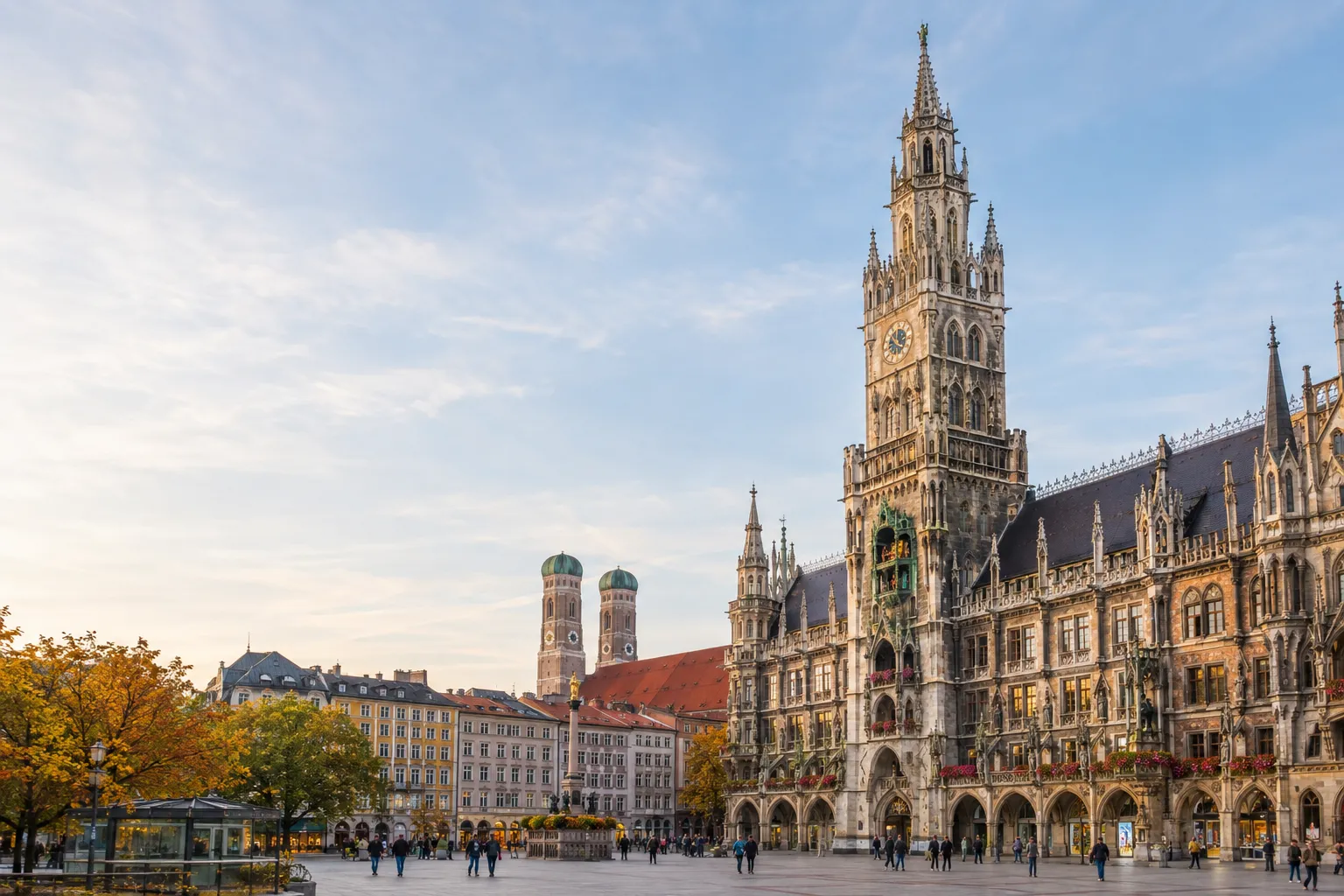
Choosing the right season for a premium stay in Munich
The right time for a premium stay in Munich depends on what you want the city to give you: spring gardens, summer outdoors, autumn’s festival calendar or winter market atmosphere. Choose the season around one clear priority, then verify current dates and opening arrangements before shaping the rest of the itinerary.
Summer favours outdoor experiences, with current facility details checked in advance.
Nymphenburg Park waterworks operating season, according to the Bavarian Palace Administration
April to October
Nymphenburg Palace Park main gate has later opening hours than in winter
May to September
Typical period for Munich Christmas markets; exact dates vary by market
Late November to shortly before Christmas
Oktoberfest dates listed for 2026; these dates have passed
19 September to 4 October 2026
The decision
Choosing the right season for a premium stay in Munich
The right season depends on the experiences you want to prioritise and the pace you want to keep.
Start with the kind of Munich stay you want
Choosing when to visit Munich is less a matter of finding one universally ideal season than of deciding what kind of stay you want. The city changes character across the year: gardens and palace grounds come into focus in warmer months; summer invites longer stretches outdoors; autumn brings a major festival period alongside quieter cultural possibilities; and winter gives the centre a distinctly seasonal atmosphere. Each choice affects the pace of the day as much as the scenery.
For a premium stay, think beyond the weather forecast. Consider how much time you want to spend outside, whether you are travelling for a particular event, how much flexibility you need, and whether your ideal itinerary is concentrated in the centre or includes parks and palace grounds. A carefully paced trip can feel considered in any season, provided the plans suit the conditions and the dates are checked before travel.
The guidance here is deliberately practical rather than prescriptive. It does not assume that a particular hotel, event or experience is included in a stay. Instead, it compares the seasonal choices through the experiences officially promoted by Munich and the Bavarian Palace Administration, then offers a framework for deciding which one suits your priorities.
The seasonal choice in brief
Munich is a year-round destination, but each season brings a different balance of daylight, outdoor opportunity and event activity. Spring and summer suit travellers who want parks, gardens and open-air experiences to shape the day. Autumn can be especially appealing to visitors drawn to the city’s major festival season, although Oktoberfest dates and visitor conditions are specific to each year. Winter rewards a more deliberate pace, with Christmas markets generally appearing from late November until shortly before Christmas, subject to each market’s own schedule.
A useful way to choose is to rank your priorities. If a particular festival is central, begin with its official dates and plan the stay around them. If the trip is mainly about gardens or outdoor movement, favour a period when those experiences are in season, while allowing for changeable weather. If you value a compact, atmospheric city break, winter may fit, so long as you are comfortable with shorter daylight and checking each market’s current opening arrangements.
“Premium” need not mean a packed itinerary. It can mean leaving room between visits, selecting a few experiences that matter, and having a sensible alternative for wet or cold weather. Seasonal planning is most useful when it helps protect that unhurried quality rather than filling every available hour.
March to May
Choose spring for gardens and an adaptable itinerary
Spring is best approached as a season of possibility, with outdoor visits supported by flexible plans.
Spring: gardens, palace grounds and a measured pace
Spring is a strong choice for visitors who want the city’s gardens and historic settings to be part of the stay without making every day a summer-style outdoor itinerary. Nymphenburg Palace Park is especially useful as a seasonal reference point: the Bavarian Palace Administration publishes different opening hours for the park’s main gate across the year, with later hours from May through September than in winter. Its waterworks operate from April to October. These details illustrate why a garden visit is best planned with the season, not simply added as a fixed year-round activity.
Spring also works well for a mixed itinerary. A morning in a park or palace setting can be balanced with indoor sightseeing, galleries, dining or time in the city centre. That combination reduces dependence on a single forecast and avoids making the visit feel like a race from one outdoor attraction to another. The exact balance should reflect the conditions during your dates, which can vary from day to day.
For a more considered spring stay, identify the outdoor experience that matters most and verify its opening arrangements close to travel. Then keep the rest of the day flexible. A park can be the focus of a clear, mild afternoon, while an indoor alternative gives the plan resilience if the weather turns. This is particularly helpful when visiting landscaped grounds, where the appeal depends on both seasonal conditions and the visitor’s willingness to walk.
Spring may be less suited to a trip whose main purpose is swimming or a fixed outdoor programme. Munich’s official visitor information notes that outdoor pools generally begin opening at different points in May, and that current hours and prices should be checked with the relevant operator. Treat the start of the warm season as a transition, not a promise that every outdoor facility will be operating on your chosen day.
Use Nymphenburg’s official visitor information to confirm park access details for your visit date.
Build a mixed day with an outdoor priority and a practical indoor alternative.
Check whether any seasonal facilities you care about have begun operating.
How to make spring feel unhurried
Spring particularly suits travellers who value the feel of a city in transition. It can be rewarding to choose a neighbourhood walk or garden visit as the day’s anchor, then leave space for an unplanned pause rather than scheduling a full sequence of outdoor stops. The approach is not dependent on a specific event or a claim about crowd levels; it simply makes the itinerary easier to adjust.
A premium itinerary in spring can also benefit from realistic expectations about daylight and comfort. Bring layers and make plans that can shift between indoors and outdoors. If the trip includes Nymphenburg, remember that the palace and park have their own visitor information, and that timings for grounds and seasonal features should be confirmed separately rather than inferred from one another.
June to August
Choose summer for Munich outdoors
Summer is the most natural fit for a stay that gives parks and other outdoor experiences a central role.
Summer: parkland, swimming and longer days
Summer gives the strongest case for a stay built around outdoor Munich. The official visitor guide highlights the Englischer Garten and its Monopteros, Eisbach wave, Japanese Tea House and Kleinhesseloher See. The range of features makes the park more than a single-point visit: it can be approached as a landscape to walk through, with distinct places to pause along the way. The guide also presents swimming facilities, Isar bathing spots and nearby lakes as seasonal possibilities.
Longer daylight can make it easier to divide a day between the city and open space. A morning devoted to museums or architecture can give way to an afternoon walk; alternatively, an outdoor day can be balanced by a slower evening. But summer should not be treated as a guarantee of uninterrupted sunshine, nor should swimming availability be assumed. Official visitor guidance advises checking current opening hours and prices for pools with the relevant operator.
The key planning question is how much outdoor time you genuinely want. If the answer is “a lot”, schedule one main outdoor experience per day rather than several distant ones. That leaves room for weather, breaks and the simple pleasure of staying longer in a place that suits the mood. If you prefer a city-focused trip, use the parks as a change of scene rather than allowing them to dominate the itinerary.
Summer’s appeal is also its demand on attention: warm conditions can change how comfortable a long walking day feels. Keep water and shade in mind, plan breaks, and avoid treating a list of attractions as a timetable. Munich’s official visitor information can help identify outdoor settings, but the day’s actual conditions should guide how much you attempt.
Treat the Englischer Garten as a destination for a relaxed walk, not a checklist of stops.
Check current operating details before making an outdoor pool or bathing visit central to the day.
Keep a shorter indoor option available if heat or rain changes the plan.
Plan outdoor days around one clear priority
Summer is a natural fit for visitors who want to combine urban exploration with outdoor pauses. The Englischer Garten offers a number of recognised points of interest, while the city’s visitor guide also describes pools, Isar locations and lakes as options. These are distinct experiences: a park walk may be easy to combine with central sightseeing, whereas a swimming outing requires checking the specific place, its arrangements and the time needed to reach it.
Rather than assuming that every seasonal activity will be available throughout summer, verify details close to the visit. This is especially important for facilities with operating seasons or changing hours. If the trip includes more than one outdoor day, vary the format: one day can centre on a park, another on an outing beyond the central streets, and another can remain largely indoors. That gives the stay variety without relying on ideal weather every day.
September to November
Choose autumn with the event calendar in mind
Autumn can centre on Oktoberfest, but it can also be planned as a city break without the festival as its organising principle.
Autumn: festival dates or a quieter city-led stay
Autumn offers two distinct propositions: a city stay shaped by seasonal change, and a visit timed around Oktoberfest. These are not interchangeable plans. If the festival is the main reason for travel, its official dates should lead the decision, with accommodation and other arrangements considered only after the relevant year’s calendar is confirmed. The Oktoberfest visitor information also provides date- and time-specific crowd guidance, a reminder that conditions can vary across the event rather than remaining constant throughout.
For 2026, the official Oktoberfest site listed dates from 19 September to 4 October. Those dates have passed as of 4 November 2026. Anyone considering a future visit should consult the official site for the relevant year instead of carrying forward dates from a previous edition. The same care applies to event arrangements and visitor guidance: details can change, and a previous year’s information is not a substitute for current instructions.
If Oktoberfest is not central to the trip, autumn can still suit a more balanced city break. Plan for cultural visits and walks, but leave room for cooler or wet conditions. Rather than building the entire stay around a festival atmosphere, decide whether you want to encounter the event as a major focus or visit Munich on dates outside it. Either choice can be coherent; the important point is to match the calendar with your expectations.
A premium stay during a major event period calls for restraint in the itinerary. Avoid combining a fixed event commitment with too many timed visits on the same day. Allow time for the journey to and from the event area, check official visitor advice, and keep any additional activity close to the day’s main focus. This is practical planning, not a claim about access, reservations or availability.
Check the official Oktoberfest site for the dates and visitor information applicable to your travel year.
Use its visitor barometer for date- and time-specific crowd guidance where available.
Decide whether Oktoberfest is the purpose of the trip or simply one possible element.
Keep event travel distinct from ordinary autumn travel
The choice between festival-focused and city-focused autumn travel is also a choice about pace. A festival visit may take up a substantial part of the day, so treat it as the principal commitment rather than one stop among many. A city-led autumn break can instead centre on a few indoor visits and a walk when conditions are comfortable, with no need to make the festival the defining feature.
Because event details and dates are time-sensitive, the most reliable planning sequence is simple: verify the official calendar, review current visitor information, then shape the surrounding days. Do not rely on an old itinerary, a past year’s dates or general assumptions about how busy a particular day will be.
December to February
Choose winter for seasonal atmosphere and a slower rhythm
Winter rewards a focused itinerary that respects daylight, current opening details and the individual character of each market.
Winter: Christmas markets and shorter, considered days
Winter changes the emphasis from extended outdoor days to atmosphere, interiors and short, purposeful visits. Christmas markets are a defining seasonal possibility: Munich’s official visitor guide says they generally run from late November until shortly before Christmas, while dates and opening hours vary by market. That variation matters. Choose the market or markets that genuinely interest you, then check their current details rather than assuming that a citywide schedule applies to every location.
Winter can suit a premium stay because it encourages selectivity. A central market visit can sit alongside indoor cultural experiences and meals, with enough time to return to a warm interior between outings. The point is not to overfill a short-light day. A smaller itinerary can feel more composed than a long list of outdoor stops, particularly when cold, rain or other conditions affect comfort.
If your visit falls outside the Christmas-market period, the winter city still calls for the same planning discipline: check opening arrangements for individual attractions, allow for shorter daylight and build in flexibility. The supplied official sources support the market season and specific visitor information, but they do not justify assuming snow, particular temperatures or a fixed winter atmosphere on any given date.
For a market visit, consider timing and location together. Markets are separate destinations with their own published details. Review the official listings for dates and hours, and avoid planning a tight chain of visits without allowing for the time needed to move between them. A single market enjoyed at an unhurried pace may be a more satisfying centrepiece than trying to cover several in one evening.
Check the dates and opening hours of the specific market you plan to visit.
Allow more time for indoor pauses and movement between winter activities.
Do not assume that snow, weather conditions or opening arrangements will match a past visit.
Make winter plans specific, not sweeping
The main trade-off in winter is straightforward: seasonal atmosphere comes with a greater need to plan around limited daylight and individual opening hours. This does not make winter less worthwhile; it changes what a well-designed day looks like. Choose one clear focal point, keep additional plans nearby where possible and leave room to adjust if the weather or timetable does not cooperate.
Visitors with particular interest in Christmas markets should use Munich’s official visitor information as a starting point, then check the selected market’s own current details. Since market dates vary, the season’s general pattern cannot answer every practical question. A plan based on verified dates is more useful than assuming all markets open together or remain open for the same hours.
Planning framework
Match the calendar to your priorities
A few deliberate questions can turn a broad seasonal preference into a practical travel decision.
A four-question method for choosing your dates
The season that looks best on paper is not necessarily the best for a particular traveller. Use four questions to make the choice concrete.
First, what is the non-negotiable experience? A festival, a garden visit, an outdoor day or Christmas markets each points towards a different part of the calendar. Second, how much flexibility do you have? A trip tied to a named event needs date-specific planning; a flexible city break can be organised around weather and interests. Third, how much outdoor time feels enjoyable rather than obligatory? A summer visit makes outdoor options prominent, but there is no need to spend every day outside. Fourth, what pace do you want? A premium stay often benefits from fewer commitments and more room to linger.
Use those answers to choose an anchor rather than a complete schedule. For example, a spring trip might have Nymphenburg Palace Park as its principal outdoor visit, supported by indoor alternatives. A summer visit might prioritise the Englischer Garten and keep pool or lake plans conditional on current arrangements. An autumn trip may be centred on Oktoberfest only after confirming dates for the correct year. A winter break can choose a specific Christmas market after checking its current schedule.
This approach also helps avoid a common planning error: treating every seasonal suggestion as an obligation. The official city guides present a range of possibilities, not a checklist that must be completed. Select a small number of experiences that fit the season and your interests, and allow the rest of the stay to remain open.
Name one seasonal experience that would make the trip feel worthwhile.
Check the relevant official dates, opening hours or visitor guidance.
Choose one practical alternative for weather or schedule changes.
Leave unstructured time around the experience that matters most.
Keep logistics grounded in confirmed local information
Travellers planning a premium stay from outside Munich should also consider how arrival and departure fit the seasonal itinerary. London Direct Chauffeurs Ltd provides pre-booked transport across London and the UK, but its confirmed service area does not establish coverage in Munich, so it is not presented here as a local Munich transport recommendation. For travel within Munich, verify local transport and access details through relevant official information rather than assuming a particular service or arrangement.
Before you go
Verify the details, then leave room to enjoy the city
Seasonal planning works best when broad guidance is paired with current official details.
A final pre-trip verification checklist
Before finalising dates, verify every time-sensitive part of the plan with the organisation responsible for it. For Nymphenburg Palace Park, consult the Bavarian Palace Administration’s current visitor information for access and seasonal details. For Oktoberfest, use the official festival site for the applicable year’s dates and visitor guidance. For Christmas markets, consult Munich’s official visitor information and then check the chosen market’s own schedule. For pools and bathing locations, confirm operating details with the relevant operator.
It is also worth distinguishing a seasonal pattern from a promise. A market season that generally runs from late November to shortly before Christmas does not mean every market is open on every date. Outdoor pools opening at different points in May does not guarantee an individual facility’s operation during a specific visit. A garden feature operating during a broad seasonal window does not remove the need to check current access information.
Keep the itinerary proportionate to the visit. Choose one seasonal centrepiece, one or two supporting experiences and a weather-proof alternative. If an event date is fixed, avoid placing other timed commitments too close to it. If the date is flexible, select the season that best suits the desired balance of outdoor and indoor time, and let the exact programme follow current conditions.
The most reliable final check is close to departure, not only when the trip is first booked. Official event pages and visitor information are the right places to verify current dates and arrangements. This article is a framework for choosing a season, not a substitute for current operating details.
Confirm event dates for the exact year of travel.
Check opening arrangements for the specific venue, park, market or facility.
Review local travel and access guidance for the day you plan to visit.
Keep at least one flexible option in the itinerary.
The considered choice
The best season for a premium stay in Munich is the one that supports the experience you actually want. Spring fits a garden-led visit with flexible plans. Summer makes parks and outdoor possibilities natural priorities. Autumn can be organised around Oktoberfest, provided dates and visitor guidance are verified, or shaped as a separate city-focused break. Winter offers a market-season itinerary when dates align, along with a strong case for shorter, more deliberate days.
There is no need to make the decision more complicated than that. Pick the season that matches your main interest, confirm the details with official sources and leave enough space for the city to unfold at a human pace. A considered stay is less about doing everything than about being in Munich at a time that suits the way you want to experience it.
Questions answered
best time to visit Munich FAQs
What is the best season for a premium stay in Munich?
There is no single best season for every visitor. Choose spring for gardens, summer for outdoor activities, autumn for a possible Oktoberfest-focused visit, or winter for Christmas markets. Match the season to your priorities and verify current details.
When do Munich’s Christmas markets usually take place?
Munich’s official visitor guide says markets generally run from late November until shortly before Christmas. Dates and hours vary by market, so check the current schedule for the location you plan to visit.
When is Oktoberfest in Munich?
Dates vary by year. The official Oktoberfest site listed 19 September to 4 October for 2026; those dates have passed. Check the official festival site for the year of your visit.
Is summer a good time to visit Munich’s parks and swimming spots?
Summer is well suited to outdoor plans, and Munich’s official visitor information covers the Englischer Garten, pools, Isar bathing spots and nearby lakes. Check current weather and facility opening details before making a particular outing central to your day.
What seasonal detail should I check for Nymphenburg Palace Park?
The Bavarian Palace Administration publishes seasonal opening information. The park’s main gate has later hours from May through September than in winter, and the waterworks operate from April to October. Confirm current visitor information for your date.