Private aviation planning for a visit to Bucharest
Planning a private aviation visit to Bucharest means coordinating the confirmed arrival airport, the first city day and any regional extension before departure. This guide explains what to verify, how to pace the capital and when Brașov belongs in the itinerary.
Confirm the exact Bucharest airport and passenger instructions with the flight operator.
Allow flexibility after landing; do not schedule a critical appointment immediately after the planned arrival time.
Principal Bucharest airports identified in national airport company information
2
Palace of Parliament visiting hours stated by its official visitor page, subject to availability
09:00–17:00
Distance from Brașov to Bran Castle stated by the regional tourism platform
35 km
Required for Palace of Parliament visits according to its official visitor information
Physical identity document
Before you fly
Private aviation arrival planning for Bucharest
A considered arrival starts with a small set of verified details. The label “Bucharest” is not enough to plan a precise pickup, hotel arrival or first appointment.
A private aviation visit to Bucharest begins with the itinerary
A private flight can make the journey to Bucharest feel more adaptable, but it does not remove the need for careful ground planning. The meaningful decisions begin before departure: which airport is confirmed for the aircraft, how arrival formalities will be handled, where the first night will be spent and whether the trip is confined to the capital or extends into Transylvania. Treat those choices as one itinerary, not as separate reservations to be reconciled on arrival.
Bucharest is both a destination in its own right and a practical starting point for exploring Romania. A compact visit can centre on the capital’s architecture, museums and civic history. A longer stay may add Brașov and nearby heritage sites, but the region calls for its own time allowance and arrangements. The central planning principle is simple: make the flight plan serve the shape of the visit, rather than allowing the arrival airport to dictate an itinerary that has not been thought through.
Confirm the airport and arrival process before departure
Private aviation is not a single airport experience. The airport named in a flight plan, the operator’s handling arrangements and the passenger’s onward journey are distinct details that should be confirmed directly with the operator. Do not assume that a scheduled-airline terminal, a private-aviation facility or a particular arrival process applies to every flight. The airport authority’s passenger information is useful for general orientation, but it does not by itself confirm arrangements for a specific private flight.
Before travel, ask the operator to confirm the airport name and address, the arrival point to use, who will meet the aircraft, what identity documents are required and whether any passenger or baggage information must be submitted in advance. Confirm how changes to the estimated arrival time will be communicated. If the flight involves an onward connection, identify who is responsible for coordinating it and what happens if the arrival time shifts. These are questions for the operator and relevant authorities, not assumptions to resolve after landing.
Henri Coandă and Aurel Vlaicu are Bucharest’s two principal airports in the national airport company’s information. Their existence does not mean a particular aircraft can use either airport or that they offer equivalent arrangements for a given journey. Have the operator verify the airport actually assigned to the flight, and use that confirmed location when planning the ground transfer and hotel arrival.
Get the confirmed airport name and passenger arrival instructions in writing.
Check identity-document and baggage requirements with the operator and relevant authorities.
Establish a single contact for arrival-time changes and onward transport coordination.
Recheck airport information close to departure rather than relying on an old itinerary.
On the ground
Build a practical Bucharest city schedule
A polished itinerary is not the one with the most stops. It is the one whose appointments, places and travel time fit together without depending on perfect timing.
Shape the first day around the real arrival time
The first hours after landing often determine whether a short city visit feels composed or compressed. Build the arrival day around the confirmed landing time, the expected time required for formalities and the distance and conditions of the onward journey. Avoid placing a non-movable appointment immediately after the scheduled arrival. Even when the flight is private, arrival processing, baggage handling and local traffic still need to be allowed for.
Choose the first destination deliberately. A hotel check-in, a quiet meal or a short orientation walk may be more useful than trying to fit a major attraction into the first evening. If the trip begins with a business meeting, confirm its location and allow a realistic buffer from the airport. If it begins with leisure, keep the first commitment optional. This modest flexibility makes the itinerary more resilient without requiring elaborate contingency planning.
For passengers who want a pre-arranged London-to-UK ground-transport provider for a separate London or UK leg, London Direct Chauffeurs Ltd offers airport transfers with flight monitoring, meet and greet, luggage assistance and 60 minutes of complimentary waiting. Those confirmed facts apply to its airport pickup service; they should not be read as a Bucharest-specific ground-service offer. For Romania, arrange onward transport with a provider confirmed for the actual destination and airport.
Plan Bucharest days by neighbourhood and appointment
City travel is easier to manage when each day has a clear geographical centre. Bucharest’s sights are spread across a large urban area, and the time spent crossing between them can change the pace of a visit. Group nearby appointments and visits together, then leave open space for meals, rest and unplanned discoveries. A map-based itinerary is more useful than a long checklist of attractions with no allowance for the movement between them.
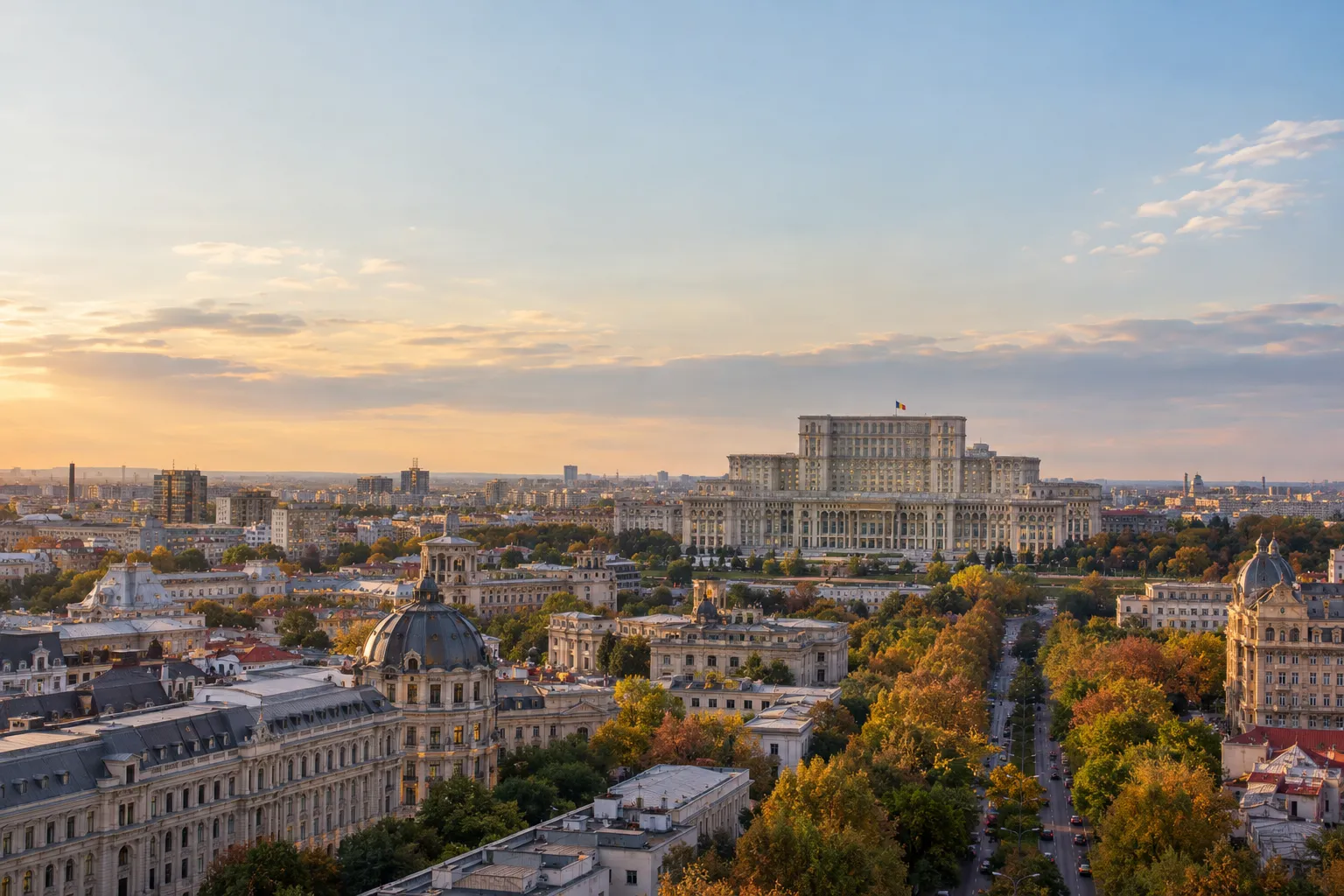
The official Bucharest visitor resource can help identify places and practical information for a city visit. For an architectural and civic-history focus, the Palace of Parliament merits advance attention. The Parliament’s visitor information states that visits are available daily from 09:00 to 17:00 subject to availability. Advance reservation requirements vary according to group size, visitors need a physical identity document and security screening applies. Treat these details as a prompt to check the official page again before fixing the day’s schedule; access and arrangements may change.
A visit to a major institution is best planned as a timed anchor rather than an assumed walk-in stop. Check the current visitor instructions, plan the journey to the entrance and avoid scheduling another distant appointment too tightly afterwards. The same principle applies to museums and other venues: verify current access information directly, especially where reservations or identity checks may apply.
Use official visitor information to confirm current opening and access arrangements.
Reserve time for travel within the city, not just for time inside each venue.
Carry the identification required by the venue and check instructions before setting out.
Keep at least one flexible period in a busy day.
The city
Make the capital the centre of the visit
Bucharest rewards an itinerary that leaves room for contrast: monumental architecture, cultural stops and the everyday city between them.
Choose a few meaningful cultural anchors
Bucharest’s visual character is layered rather than uniform. Wide boulevards and substantial civic buildings sit alongside quieter streets, churches and residential districts. A first visit can be more rewarding when it balances landmark architecture with time to understand the city at street level. That balance also makes the itinerary less dependent on any single attraction or timed admission.
The Palace of Parliament offers a particularly clear case for advance planning because official visitor arrangements include reservations, identity checks and security screening. It is not a stop to add casually between other commitments. If it is central to the visit, let it shape the surrounding schedule. If the available arrangements do not fit the day, choose other city experiences rather than treating entry as guaranteed.
For a different perspective, combine a formal landmark with a museum, a walk through a selected district or a long meal. The city’s official visitor pages are a sensible starting point for current local orientation, while individual venues should be checked for their own rules. Where opening details, closures or admission conditions matter to the itinerary, verify them close to the date instead of relying on older guide material.
Set the pace before adding more places
The right duration depends less on a standard list of “must-sees” than on the purpose of the visit. A short business stay may leave room for one carefully chosen cultural visit. A dedicated city break can support a more relaxed rhythm with time for architecture, museums and neighbourhood exploration. A Romania itinerary that includes Brașov should reserve enough time for the regional journey and the experiences there, rather than treating it as another stop in central Bucharest.
One useful planning method is to divide the trip into three layers: fixed commitments, priority experiences and optional additions. Fix appointments and any venue visit requiring advance arrangements first. Add one or two priority experiences each day, taking location and travel time into account. Keep optional ideas in reserve. This prevents an attractive but overfull plan from turning every delay into a compromise.
Season, daylight and personal energy also affect the feel of a city visit. Rather than relying on a generic itinerary, check the actual dates, opening information and local conditions that apply to your stay. If the visit is connected to a conference or business meeting, leave enough margin around the fixed event to account for changes in the programme.
Separate immovable commitments from preferred and optional activities.
Anchor the day with one or two priority experiences, not a crowded list.
Confirm access requirements for any venue that matters to the trip.
Reserve a buffer before a flight, appointment or intercity journey.
Beyond the capital
Add Brașov with realistic time and travel expectations
A regional extension can transform the character of a visit, but only if it has enough time to feel like a destination rather than a rushed detour.
Treat Brașov as a deliberate regional extension
Brașov can provide a striking counterpoint to the capital, with a historic centre and access to a wider range of Transylvanian heritage and outdoor experiences. The regional tourism platform highlights Brașov’s historic attractions and lists nearby places including Bran Castle, Râșnov Fortress and the fortified church at Prejmer. These are distinct destinations, not interchangeable stops, and each has its own current access arrangements to verify.
Decide first whether Brașov is a separate overnight stay, a longer regional visit or only a potential extension. The answer changes how much you can reasonably include. An overnight stay gives more room to experience the town without making the day revolve around travel. A day excursion may be possible in some itineraries, but it should not be treated as effortless or guaranteed; journey time depends on the chosen transport and conditions. Check current transport options and actual journey estimates before setting an appointment or admission time.
Bran Castle is listed by the Brașov tourism platform as 35 kilometres from Brașov. That distance is useful context, not a complete travel-time estimate and not proof of convenient access on a particular day. If it is a priority, check its official visitor information and transport arrangements, then decide whether it belongs in a Brașov-based day or warrants a separate plan. Avoid stacking several regional sights simply because they appear close together on a map.
Choose whether Brașov is an overnight stay or a day excursion before booking the rest of the itinerary.
Check current journey options and travel conditions for the dates of travel.
Verify each attraction’s own visitor information and opening arrangements.
Allow time for the return journey rather than planning only the outward leg.
Choose depth over an overextended Romania itinerary
A Bucharest-to-Brașov plan is more than a transfer between two city names. It involves a change in the character and scale of the trip. The capital is a broad urban destination; Brașov is a base for a different mix of historic streets, regional heritage and surrounding landscapes. Travellers who want both should decide how much of the visit belongs to each, then set the flight and hotel dates around that balance.
For a tightly scheduled visit, a one-city itinerary may be the more considered choice. For a longer stay, Brașov can add a regional dimension, especially when paired with a small number of nearby places selected for genuine interest. Check official local tourism sources for current visitor context and individual sites for access details. Do not assume that a particular tour, private access or transport arrangement is included simply because a destination is commonly visited.
The broad lesson for private aviation planning is to avoid designing the whole trip around the shortest possible ground connection. A direct flight can make arrival more adaptable; it cannot compress Romania’s geography or guarantee that every desired stop will fit comfortably. Build the schedule around the experience you want, then confirm the logistics that make it feasible.
Travel readiness
Check documents, coordination and contingencies
Official guidance and clear responsibilities matter more than assumptions about what a private flight automatically provides.
Verify travel requirements with the right authorities
The flight itself is only one part of the planning picture. Before confirming travel, review the current requirements relevant to each traveller’s nationality, documents and itinerary through official government guidance. Entry rules can differ by circumstance and may change. Do not rely on a third-party summary where a current official source is available.
Ask the flight operator which documents, passenger details and baggage information it needs, and when. Confirm who is responsible for any required flight permissions or operational arrangements. The passenger should not assume that the operator’s aircraft arrangements automatically satisfy personal entry requirements. Keep the flight itinerary, accommodation information and contact details accessible, while following the operator’s instructions for handling sensitive information.
Travel advice should be checked close to departure, not only when the trip is first imagined. The United States Department of State and Government of Canada maintain Romania travel information for their respective audiences; travellers should consult the guidance issued by their own government. Airport authority pages are useful for passenger-facing airport information, but operational questions about a particular private flight belong with the operator and airport contacts.
Check current entry and travel advice from the government relevant to your nationality.
Confirm passenger-document requirements with the flight operator.
Ask who handles operational permissions and passenger arrival coordination.
Recheck the official information before departure if the itinerary changes.
Keep the itinerary resilient to changes
A calm plan includes contingencies without becoming a catalogue of worst cases. Identify which parts of the itinerary are fixed, which can move and whom to contact if the arrival time changes. If a major venue appointment depends on a precise arrival, make sure the reservation terms are understood and avoid an unnecessary chain of commitments beforehand. If the visit includes an onward journey, confirm the change and cancellation terms directly with the relevant providers.
Keep essential contact information available to the people travelling, including the flight operator, accommodation and any confirmed local transport provider. Agree on a practical meeting point and a method for communicating changes. For a group, confirm who has the current itinerary and whether any traveller has a separate document or mobility requirement that needs attention.
This is also where restraint improves comfort. A plan with one reliable arrival arrangement, a manageable first day and a small number of confirmed priorities is usually more robust than one that depends on a succession of precise connections. The objective is not to anticipate every disruption, but to ensure that a change in timing does not unravel the entire visit.
Putting it together
A composed private aviation visit to Bucharest
Use this final review to connect the flight, the first city day and any regional extension into one workable plan.
A final planning checklist for a Bucharest arrival
Before the trip, make one concise itinerary that links the flight details to the first ground destination. Include the confirmed airport, arrival instructions, operator contact, accommodation address, any fixed venue reservations and the onward travel plan. Record which details still need confirmation, rather than allowing an unverified assumption to look like a settled arrangement.
A useful final check is to test the itinerary from the traveller’s point of view. What happens after landing? Who is expected to meet the passenger, and where? How much time is available before the first commitment? If the arrival shifts, which item moves first? Are the visitor rules for the chosen attraction current? Does the Brașov plan include a realistic return or overnight arrangement? These questions expose gaps while there is still time to address them.
Private aviation can bring flexibility to a visit, but the value of that flexibility depends on thoughtful decisions on the ground. Confirm the airport and operator arrangements, give Bucharest enough time to be experienced as a city, and add Brașov only when the length and purpose of the trip support it. The result is not a more elaborate itinerary, but a more coherent one.
Confirmed airport and flight-operator instructions
Current travel-document checks for every traveller
First-day schedule with room for arrival and local travel
Verified venue reservations and visitor requirements
A realistic decision on whether to include Brașov
Let the flight serve the journey
The best starting point is a clear purpose: business in the capital, a cultural city break, or a wider Romanian journey. Let that purpose set the number of nights and the pace. Confirm what the flight operator and official sources can establish, leave uncertain details open until verified, and resist the temptation to treat every nearby place as an obligatory stop.
With those decisions made, the arrival becomes part of the experience rather than a logistical interruption. Bucharest can be explored at a measured pace, while a regional stay in Brașov can be given the time it deserves. That balance is the quiet advantage of good planning: the journey feels considered because its details have been resolved before they become urgent.
Questions answered
FAQs
Which airport should I use for a private flight to Bucharest?
Confirm the airport assigned to your specific flight with the operator. Bucharest Airports identifies Henri Coandă and Aurel Vlaicu among the city’s principal airports, but that does not establish which airport is appropriate or available for a particular aircraft.
Can I visit the Palace of Parliament without arranging it in advance?
Do not assume walk-in access. Its official visitor information says visits are subject to availability, advance reservation requirements vary by group size, visitors need a physical identity document and security screening applies. Check the official page before travel.
Is Brașov suitable as a day trip from Bucharest?
That depends on your itinerary and current transport conditions. Check journey options and travel time for your dates before committing to a day visit; an overnight stay may suit a slower regional itinerary better.
Does a private flight arrange entry requirements for Romania?
Do not assume it does. Check current entry advice from the government relevant to your nationality and confirm flight-operation and passenger-document requirements with the operator.