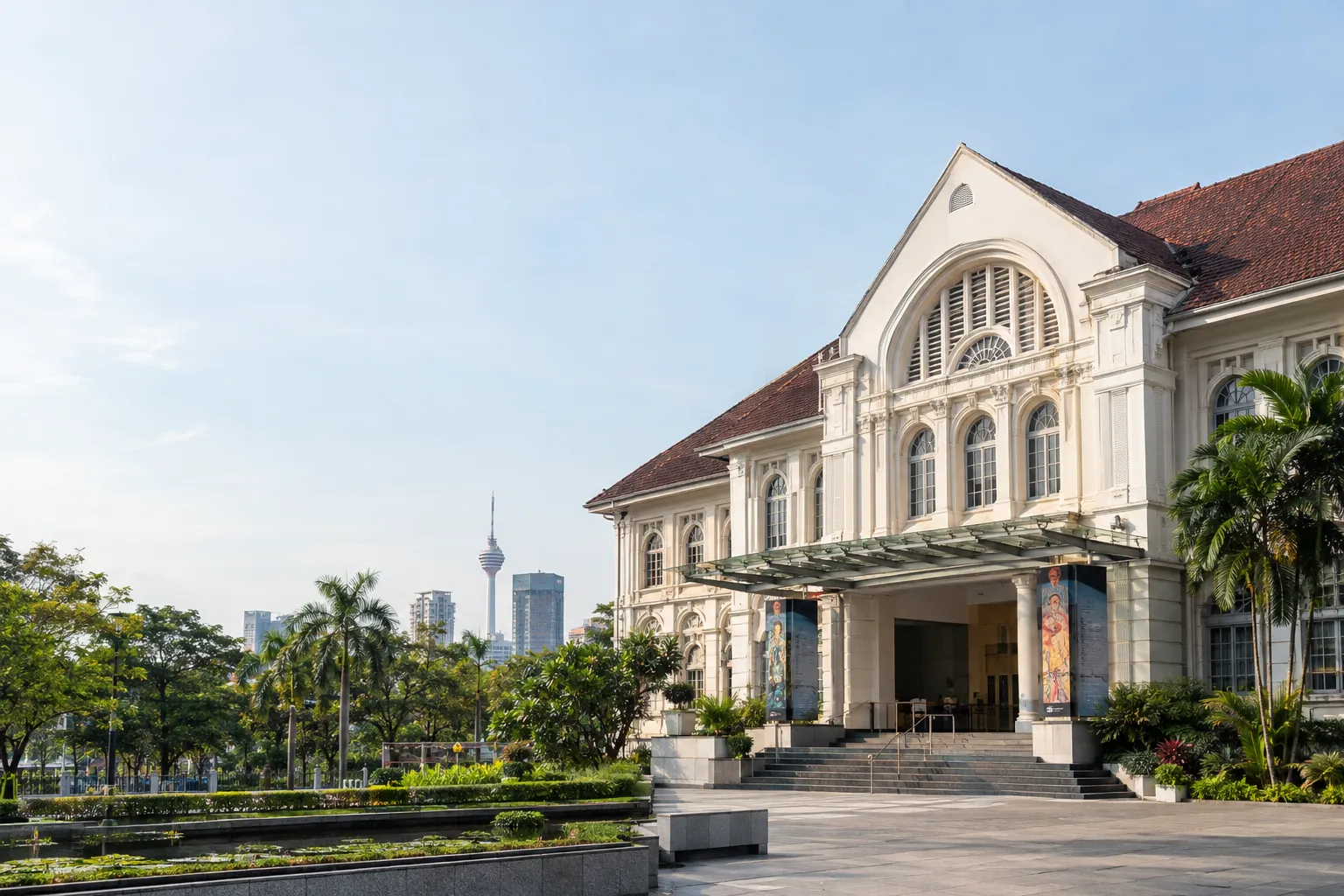
Kuala Lumpur’s art museums invite different kinds of looking. At Balai Seni Negara, Malaysian visual art provides a point of entry into the country’s artistic life. Islamic Arts Museum Malaysia expands the frame to art and material culture across the Muslim world, while Bank Negara Malaysia Museum and Art Gallery places art alongside money, economics and Islamic finance. The right choice depends less on a ranking than on the questions you want to take into the galleries. This guide compares their distinct perspectives and offers a practical way to plan a visit, with current details checked directly against each institution’s official visitor information.
A considered way to explore Kuala Lumpur’s art museums
Kuala Lumpur rewards visitors who approach its art museums as distinct cultural conversations rather than interchangeable indoor attractions. The city’s collections range from Malaysian visual art to objects and design from across the Muslim world, while the Bank Negara Malaysia Museum and Art Gallery places artworks alongside histories of money and economic life. Together, these institutions offer several ways to read the region: through artists and national identity, through the movement of artistic ideas across cultures, and through the everyday systems that shape society.
A thoughtful visit begins with a question. Are you hoping to encounter Malaysian artists and changing exhibitions? Do you want to spend time with Islamic art, architecture and craft? Or would you prefer a museum that brings art into a wider account of Malaysia’s financial and economic history? Choosing a principal interest makes the day more rewarding than trying to collect a checklist of venues.
The practical details matter, too. Museums can revise schedules, admission arrangements and exhibition programmes. Use the official visitor information for the specific date of your visit, and leave space for a slower pace: a gallery is not best measured by how many rooms can be crossed in an hour. The most memorable moments often come from comparing a handful of works, noticing how a material has been handled, or returning to a display after seeing something else.
Three institutions, three different perspectives
Kuala Lumpur’s art institutions offer complementary perspectives, not a single account of art. The National Art Gallery, also known as Balai Seni Negara, is the natural starting point for visitors interested in Malaysian visual art. Its exhibitions and collection displays can provide a sense of how artists have represented the country and its changing cultural life. The museum’s official visitor page lists its Kuala Lumpur location and daily opening hours; check that page again before visiting, especially if your plans depend on a particular exhibition.
Islamic Arts Museum Malaysia (IAMM) offers a different scale and frame. The museum describes a collection spanning more than a millennium of art, design and culture of the Muslim world. That breadth encourages visitors to think beyond national boundaries and beyond the idea that Islamic art is one style. Objects, techniques and visual languages reflect varied places, periods and uses. Allow time to look closely at form and detail rather than treating the galleries as a rapid survey.
At Bank Negara Malaysia Museum and Art Gallery, art forms one part of a broader museum experience. Its galleries extend across four levels and include art, economics, Islamic finance and numismatics. This combination can make the visit especially engaging for people curious about how cultural objects sit within the histories of institutions and everyday exchange. The museum’s official visit page sets out current admission, opening and visitor information.
These distinctions are useful when choosing where to spend limited time. A visitor seeking a focused encounter with Malaysian visual art may begin at the National Art Gallery. Someone drawn to artistic traditions and material culture across the Muslim world may give IAMM the main part of the day. Those interested in connecting art with economics, money and institutions may find the Bank Negara museum’s combined subject matter compelling.
Begin with Malaysian visual art at Balai Seni Negara
Balai Seni Negara is an important point of reference for understanding the capital’s public art landscape. Its exhibitions provide a setting in which to encounter Malaysian art through both historical and contemporary perspectives, though the precise works on view vary. For that reason, checking the gallery’s current exhibition information before travelling is more useful than relying on an older itinerary or an assumption that a particular display will remain open.
A gallery visit benefits from a little structure. Before entering, decide whether you want to follow a broad overview or spend time with a few works that catch your attention. Read labels selectively, noting the artist, date, material and context when they clarify what you see. Then look again without reading: consider scale, surface, colour, composition and the relationship between the work and the surrounding room. This alternation between information and direct observation can make a visit feel both informed and personal.
The gallery’s visitor information lists daily opening hours of 9 a.m. to 5 p.m. and provides the venue’s address. Because visitor arrangements can change, confirm the current details directly before setting off. The official FAQ and visitor pages are useful places to check practical questions and any updates. If an exhibition is your principal reason for going, verify that it is running on the intended day and allow time for any exhibition-specific guidance.
Rather than trying to summarise Malaysian art through a handful of labels, treat the gallery as an invitation to notice different voices and approaches. A work may speak through a familiar image, a material associated with a particular craft, or an unexpected formal choice. Looking with curiosity, and accepting that not every work needs an immediate explanation, is a sound way to begin.
Read across cultures at Islamic Arts Museum Malaysia
IAMM’s collection offers an expansive introduction to the visual and material cultures of the Muslim world. Its stated scope spans more than a thousand years, which is a reminder to resist treating Islamic art as a narrow category or a single visual language. The collection invites comparison across different contexts and forms, with the viewer’s attention moving between design, craftsmanship, ornament and the purposes objects were made to serve.
One useful way to explore is to choose a visual thread and follow it. It might be a recurring geometric idea, the treatment of written forms, a material or a particular approach to decoration. Ask how the same broad principle changes from one object or period to another. Such comparisons help reveal both continuity and difference without flattening the range of cultures represented.
IAMM’s official visit page provides current operating arrangements and admission information, as well as public-transport options. Check those details in advance. The museum also identifies nearby sights, including the National Mosque, Perdana Botanical Garden and the old railway station. These are useful reference points for understanding the surrounding area, but they do not create a guaranteed route or timetable. Decide whether you would rather extend the day with another nearby stop or keep the museum as the focus.
A visit can be rewarding even when approached without specialist knowledge. Spend time with the objects that draw your attention, then use the museum’s interpretive material to add context. Looking at how an object is made, how it is decorated and how it might have been used can open up questions that a quick photographic record cannot answer. The value lies in sustained looking, not in trying to see every display at speed.
Art alongside economics at Bank Negara Malaysia Museum and Art Gallery
The Bank Negara Malaysia Museum and Art Gallery provides an opportunity to see art within a wider institutional narrative. Its four-level gallery arrangement encompasses art alongside economics, Islamic finance and numismatics. That combination makes the venue a useful choice for visitors who enjoy moving between visual experience and questions about how a society records value, exchange and change.
The art displays can be approached on their own terms, but the surrounding subjects add another layer. A work seen near material about money or economic life may prompt a different set of questions from one encountered in a standalone art museum. What does an object reveal about the period in which it was made? How do images, objects and financial systems shape collective memory? The museum’s breadth gives visitors room to make such connections without requiring them to arrive with a specialist background.
Practical information on the official visitor page states that admission is free, entry is walk-in, and the museum is open Tuesday to Sunday. It also provides visitor guidelines and notes wheelchair and stroller access. These are current-source details rather than a substitute for checking the page before a visit: public holidays, temporary arrangements or other updates may affect plans. Read the rules carefully if you have a particular access need or are visiting with children.
Because the museum covers several subjects, it is worth deciding in advance what you most want to see. Visitors primarily interested in art can give those displays priority while leaving time for one or two of the other galleries. Those with an interest in monetary history may prefer to move between the art and numismatic material. A flexible plan makes the collection’s variety an advantage rather than a reason to rush.
Plan a museum day without turning it into a checklist
A multi-venue museum day can be appealing, but it should be planned around attention as much as geography. IAMM’s visitor information names several nearby cultural and civic sights, including the National Mosque, Perdana Botanical Garden and the old railway station. These references can help you understand the area and consider a wider day out. They are not a promise of a particular walking route, journey time or access arrangement, so check maps and current local conditions independently.
Choose one museum as the anchor. If your main interest is Malaysian visual art, centre the day on Balai Seni Negara and check the current exhibition programme. If the art and material culture of the Muslim world is your priority, allow IAMM the time it merits. If you want a broader museum visit that includes art, finance and money, plan around Bank Negara Malaysia Museum and Art Gallery. Adding a second stop is most satisfying when it complements the first rather than competing for the same limited hours.
Before leaving, confirm the venue’s location, opening arrangements, admission information and any visitor guidelines. For public transport, consult the museum’s own guidance where available and verify the relevant service information for your date. If mobility, a stroller or a particular access requirement is part of your planning, check the official venue information directly rather than assuming that all galleries have identical facilities.
Keep a modest margin between visits. Time to eat, pause or reconsider the plan can protect the quality of the museum experience. If you arrive later than expected, it may be better to explore one collection attentively and leave another venue for a separate day. The city’s art museums are more rewarding as places to spend time than as entries to tick off.