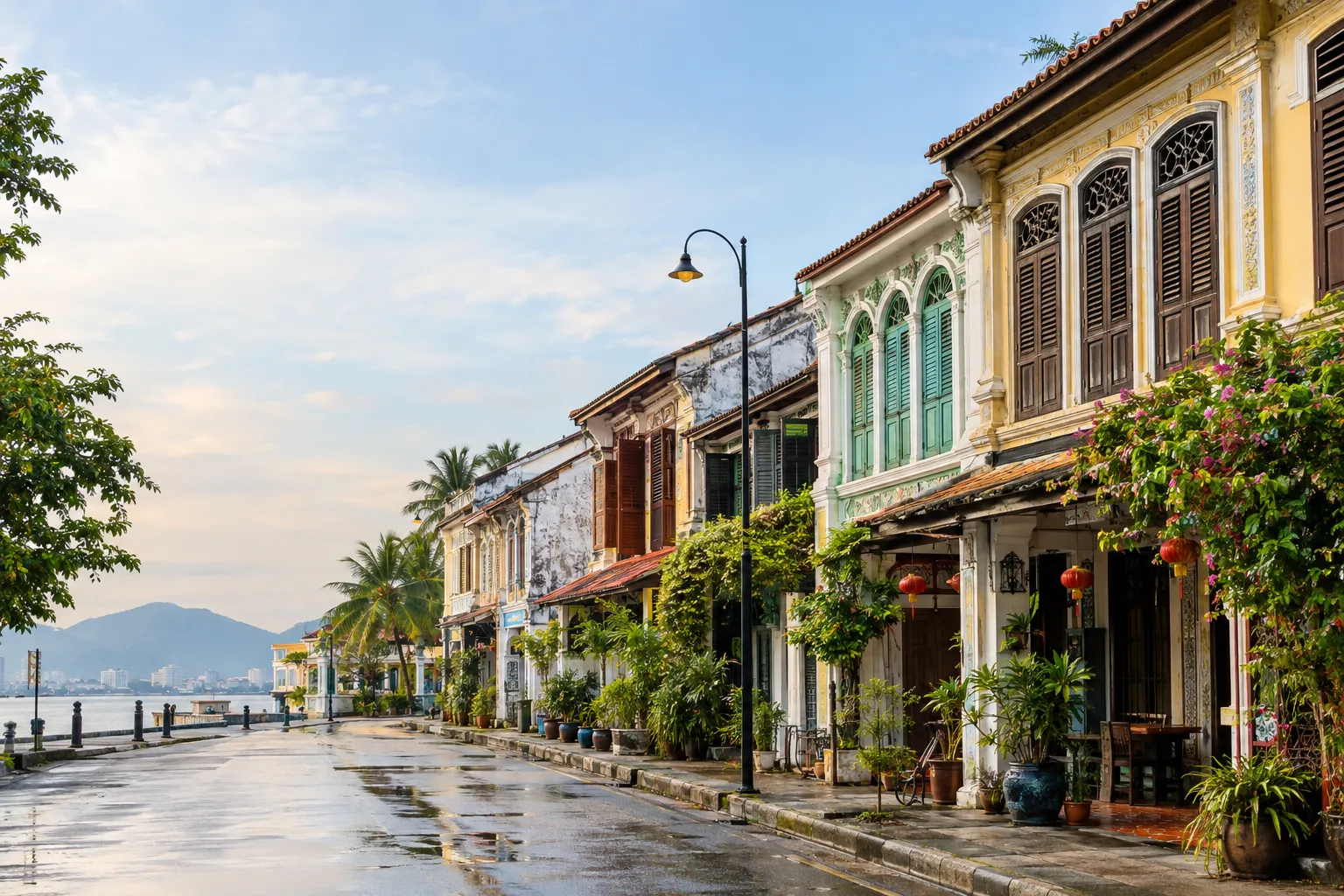
Choosing the right season for a premium stay in George Town
George Town is rewarding across the year, but the feel of a stay changes with the weather. Use regional climate patterns to choose dates, then shape a flexible itinerary around the city’s heritage, food and cultural life.
Use January–February and June–July as relative rainfall-minimum reference periods for the northwestern region, not as guaranteed dry months.
Expect warmth and humidity throughout the year and check a current forecast near travel dates.
Relative rainfall minima identified for Malaysia’s northwestern region by METMalaysia
January–February and June–July
Period when METMalaysia notes early-morning Sumatras affecting the southwest coastal area
May–August
Suggested duration of the official George Town Culture & Heritage Trail, excluding meals
7–8 hours
Funicular operating hours stated in Penang Hill Corporation’s FAQ; check current updates and maintenance notices
6:30 a.m.–11 p.m.
At a glance
What seasonality means for a George Town stay
Two principles help frame the decision: seasonal rainfall patterns can inform, but not guarantee, conditions; and George Town’s historic centre offers experiences beyond outdoor sightseeing.
Choosing the right season for a premium stay in George Town
A premium stay in George Town is less about finding a perfect weather window than choosing the conditions that best suit the way you want to spend your time. The city rewards an unhurried pace: a morning among historic streets, a pause for a long lunch, a visit to a museum or heritage interior, then an evening shaped around Penang’s food and layered cultural life. Rain may alter the rhythm, but it need not erase the character of the day.
Malaysia is warm and humid, and rainfall patterns differ across the country. METMalaysia’s climate guidance identifies relative rainfall minima in the northwestern region in January to February and June to July. These are broad regional patterns, not a promise of clear skies in George Town on any particular date. For a discerning traveller, the useful question is therefore not simply “When is it dry?” but “Which season best fits my tolerance for rain, preferred pace and plans beyond the historic centre?”
A considered overview: climate, heritage and pace
This is a city to experience in layers. George Town is part of the UNESCO-listed Historic Cities of the Straits of Malacca, a port settlement whose architecture and living cultural traditions reflect centuries of exchange. That heritage is not confined to a single monument or indoor attraction; it is present in the street pattern, religious buildings, shopfronts, public spaces and food culture. A well-paced stay can therefore draw on more than one kind of day.
The season matters because it changes the balance between walking, resting and adapting. A relatively drier period may suit travellers hoping to spend more time outdoors, while a visit during a wetter spell can still be rewarding when the itinerary includes indoor stops and flexible breaks. The aim is not to predict every shower, but to choose dates and a style of stay that remain enjoyable if the weather changes.
Climate in context
Rainfall patterns, humidity and realistic expectations
Seasonal information is most useful when it helps set expectations without creating false certainty.
How to read George Town’s tropical climate
Malaysia’s climate is tropical, with warmth and humidity present across the year. In its overview of regional climate, METMalaysia notes that rainfall varies from one part of the country to another. For the northwestern region, the guidance identifies January to February and June to July as periods with lower rainfall totals relative to other parts of the year. It also notes that early-morning “Sumatras” can affect the southwest coastal area from May to August.
These observations are useful for broad planning, but they should not be translated into a guarantee that a particular month will be sunny or rain-free in George Town. Local showers can still affect an individual day, and conditions may vary within a trip. Read seasonal information as context, then check a current forecast nearer departure and remain ready to adjust outdoor plans.
For a stay where open-air exploration is central, those relative rainfall minima may be a reasonable starting point for comparing dates. If you are comfortable adapting your day and value the city’s interiors, food and cultural settings as much as its streets, the calendar can be approached more flexibly. A premium experience is often created by leaving room in the schedule, rather than trying to make every hour depend on clear skies.
Use METMalaysia’s regional climate guidance to compare broad seasonal patterns, not to predict the weather on a specific day.
Check a current forecast close to travel and again during the stay.
Avoid treating any month as reliably dry; plan alternatives for rain and heat.
Why a rainfall minimum is not a weather guarantee
A relative rainfall minimum is not the same thing as a dry season in the sense some visitors may expect from temperate destinations. The phrase describes a pattern in regional rainfall, not a guarantee of uninterrupted sunshine. In practical terms, it may improve the odds of longer outdoor windows compared with wetter parts of the year, but a traveller should still expect humidity and the possibility of rain.
The May-to-August note about early-morning Sumatras is another reason to avoid oversimplifying a seasonal choice. It describes a weather phenomenon affecting the southwest coastal area, but does not determine the conditions for every morning in George Town. If an early walk or outdoor excursion matters, make it a flexible plan rather than the sole purpose of a day.
A sensible packing and scheduling approach matters in any season: choose light clothing suited to warm, humid conditions, carry rain protection, and keep an indoor option in mind. These are practical responses to the region’s climate, not a claim that any particular day will bring rain.
The historic centre
Plan a heritage stay that can adapt
The city’s heritage is an enduring reason to visit, while seasonal weather determines how to pace its outdoor elements.
Heritage streets are rewarding in more than one season
George Town’s historic core rewards attention to detail. UNESCO’s account of the historic cities describes a port environment shaped by trade and cultural exchange, with a distinctive built heritage and living traditions. The streets are not merely a route between attractions: they are part of the experience, connecting architectural forms, places of worship, commercial buildings and everyday urban life.
The official Penang Culture & Heritage Trail offers a useful framework for a substantial day, listing a sequence of places that includes Esplanade, Fort Cornwallis, the Street of Harmony, museums, Khoo Kongsi, Armenian Street and the Clan Jetties. The suggested trail is presented as a 7–8-hour experience excluding meals. That duration is a planning reference rather than a promise about how long every visitor will take, and the itinerary should be adapted to interests, weather and current access at individual sites.
In relatively drier conditions, the route’s outdoor links may feel more straightforward. In unsettled weather, slow the pace: spend longer at a suitable indoor stop, take a meal break, or divide the route across more than one day. A flexible plan preserves the sense of discovery and avoids turning a heritage visit into a race from one landmark to another.
Choose a few places that matter most to you instead of treating every trail stop as compulsory.
Allow time for meals and unplanned pauses; the official trail’s stated duration excludes meals.
Check individual site access and opening information close to your visit.
Build a rain-ready heritage itinerary
Rain can make long periods outdoors less comfortable, but it can also be an invitation to change the emphasis of a day. George Town’s appeal includes its architectural detail, museums and cultural settings as well as its streets. A carefully chosen indoor pause gives the day a different cadence: observe a building or collection with more attention, take time over a meal, and return outdoors when conditions allow.
The best fallback is not necessarily a tightly scheduled list of indoor attractions. Instead, leave space between planned stops and identify a small number of alternatives that are genuinely of interest. The official heritage trail is a starting point for shaping a route, not a substitute for checking whether a particular site is open or suitable on the day.
For travellers seeking a more composed stay, this matters as much as choosing a season. A deliberately light itinerary leaves room to respond to weather without losing the purpose of the visit. It also creates time to notice the city as a living place rather than a collection of boxes to tick.
The daily experience
Meals, pauses and a more thoughtful pace
Food, rest and a flexible schedule can make a visit feel complete without requiring perfect weather.
Let food shape the rhythm of the stay
For many visitors, food is not a side activity but one of the central ways to understand Penang. Tourism Malaysia describes the state through its culinary variety and the experience of its food traditions. A stay planned around meals can soften the pressure to make every day an uninterrupted outdoor itinerary: a thoughtful lunch or dinner gives the day a natural pause, whatever the sky is doing.
Rather than choosing dates solely for a particular meal or assuming a venue’s hours, make food plans around confirmed information from the places you intend to visit. Check details directly before travel, especially when a specific restaurant, market or dining experience is central to the trip. The sources available for this guide support Penang’s broad culinary character, but not fixed opening schedules or guarantees about individual businesses.
A premium stay need not be defined by a long list of reservations. Consider the balance between a planned meal and the freedom to follow local recommendations once in the city. That approach gives the itinerary structure without making it brittle, and it sits naturally alongside a heritage-focused day.
Treat meals as meaningful pauses in the day, not merely gaps between sightseeing stops.
Confirm current opening arrangements with any specific venue you plan to visit.
Keep at least one meal period flexible if weather changes the timing of outdoor plans.
A slower pace makes the season less decisive
A premium trip often feels most considered when it is paced with restraint. In warmer, humid conditions, a long walk is more comfortable when it is broken into manageable stretches with pauses. In rain, the same principle applies: reduce the number of transitions and choose a few experiences to enjoy more fully. The details of the schedule can be adjusted once you know the forecast and the current arrangements at the places you wish to see.
George Town lends itself to a day with several different textures: a heritage walk, an extended meal, an indoor cultural visit and time at leisure. The order can change with the weather. On a brighter day, place the longer walk earlier or later to suit your comfort; on a wet day, bring an indoor stop forward and revisit the outdoor route when conditions improve. These are itinerary choices, not claims about guaranteed hours of sunshine or venue availability.
Beyond the heritage core
Seasonal planning for a Penang Hill visit
An excursion can broaden the stay, provided access and conditions are checked rather than assumed.
Decide whether to add Penang Hill
Penang Hill offers a contrasting landscape beyond the historic centre and may appeal to visitors who want to include a nature-oriented outing. It is an optional excursion, not a necessary part of a George Town stay, and it introduces another set of practical considerations: weather, access and current operations. The Penang Hill Corporation publishes visitor information and an FAQ that gives the funicular’s operating arrangements, while also noting that scheduled maintenance may affect service.
Because operating details can change, verify the latest information from the official operator before setting out. Do not build a time-sensitive itinerary around an old timetable or assume that a particular service will be running on a chosen date. Conditions on the hill may also differ from those in the city, so check the forecast and make a decision based on current information.
If a hill visit is important to you, give it its own flexible window rather than placing it between two fixed commitments. If conditions or operations are unsuitable, the historic centre offers a substantial alternative. A careful choice between these experiences is more useful than trying to include every possible outing regardless of the day’s circumstances.
Check Penang Hill Corporation’s current visitor updates and maintenance information before travel.
Confirm the funicular’s current operating arrangements on the day you plan to visit.
Keep an alternative in George Town in case weather or operations affect the outing.
Make excursions an option, not a fixed assumption
The choice between a city-focused stay and a broader island itinerary depends on what you value most. If architecture, food and cultural discovery are the priorities, George Town itself can anchor the visit across different seasons. If a hill excursion is essential, compare your preferred travel dates with regional climate guidance, then confirm the specific conditions and transport arrangements nearer the time.
This is where seasonality becomes personal. Travellers who want long outdoor walks may prefer dates associated with the regional rainfall minima, while visitors comfortable with indoor pauses and a less predictable rhythm may have greater flexibility. Neither approach is inherently superior. The right choice is the one that matches your interests and leaves space for the realities of tropical weather.
A decision framework
Choose dates by matching weather to your priorities
Use broad climate information to narrow your options, then test the plan against your interests and current local arrangements.
A practical way to choose your dates
A simple decision framework can make date selection clearer. First, decide whether your priority is extended outdoor exploration or a more varied programme with indoor pauses. Second, use METMalaysia’s regional rainfall guidance as context: January to February and June to July are identified as relative rainfall minima for the northwestern region, while May to August is noted for early-morning Sumatras affecting the southwest coastal area. Third, consider how much flexibility you want in the itinerary. Finally, check the forecast and any relevant attraction arrangements close to the date.
For travellers prioritising outdoor heritage walks, the relative rainfall minima may be the more appealing starting point. For travellers whose plans are centred on architecture, food, museums and flexible exploration, more dates may work, as long as they are prepared for warmth, humidity and the possibility of rain. In either case, avoid scheduling every important experience outdoors on one day.
There is no need to make the trip a contest against the climate. Leave enough time to sit down, take a meal, shelter if needed and return to a route when conditions are more comfortable. A considered stay is not one in which every forecast is perfect; it is one in which the plan can absorb change without sacrificing its central purpose.
For outdoor-first plans, compare dates with the regional rainfall minima but retain a weather contingency.
For culture- and food-led plans, choose dates with more flexibility and build in indoor time.
For any trip, recheck the forecast, site access and official operating information before departure.
Confirm the details that can change
Before confirming the final itinerary, check the details that are most likely to affect the day: current weather, access to specific heritage sites, and the latest information from any attraction outside the city centre. Tourism and heritage trails are useful planning references, but they do not confirm the opening arrangements of every stop on a particular date. Where a named place matters to your plans, consult its own current guidance.
If you want to include private transport as part of a wider UK-based journey, London Direct Chauffeurs Ltd provides pre-booked transport across London and the UK; its confirmed service area does not include Malaysia. For a George Town stay, make local transport arrangements using current, destination-specific information rather than assuming this publisher operates there.
Final perspective
Choosing the right season for your George Town stay
Seasonality can guide the decision, but the quality of the stay comes from matching dates, interests and pace.
The best season is the one that fits your plans
There is no universally correct season for a premium stay in George Town. January to February and June to July are useful reference periods because METMalaysia identifies them as relative rainfall minima in the northwestern region. They may suit visitors who want to give outdoor exploration a greater share of the itinerary, but they do not promise dry days. The May-to-August note on early-morning Sumatras is additional regional context, not a reason to assume every morning will be affected.
The most reliable approach is to choose the kind of stay you want first. Let the city’s heritage, food and cultural life set the purpose; use seasonality to understand the likely trade-offs; and keep the schedule flexible enough to respond to actual conditions. Check current forecasts, attraction access and operational updates before travelling, particularly for Penang Hill.
A well-chosen visit is ultimately a matter of fit: dates that suit your interests, an itinerary that respects the climate, and enough breathing room to experience George Town at a human pace.
A considered conclusion
Think of the calendar as a guide to possibilities rather than a verdict on when the city is worth visiting. When outdoor time matters most, compare dates with the regional climate pattern and prepare a rain-ready alternative. When your interests are broader, allow the heritage centre, meals and indoor experiences to carry more of the day. Either way, verify current conditions and access rather than relying on seasonal averages alone.
Questions answered
best time to visit George Town Penang FAQs
What are the drier periods for visiting George Town?
METMalaysia identifies January to February and June to July as relative rainfall minima in the northwestern region. These are regional patterns, not a guarantee of dry weather in George Town on specific dates.
Is George Town worth visiting during a wetter period?
The city’s heritage, food and cultural experiences are not limited to outdoor walks. Plan indoor pauses, keep the schedule flexible and check current weather and venue access.
Should I plan a Penang Hill visit in advance?
Yes. Check Penang Hill Corporation’s current visitor information, funicular arrangements and maintenance updates before setting out, as operating details may change.
How long does the George Town Culture & Heritage Trail take?
Penang’s official tourism itinerary suggests 7–8 hours excluding meals. Treat this as a planning reference and check current access arrangements for individual stops.