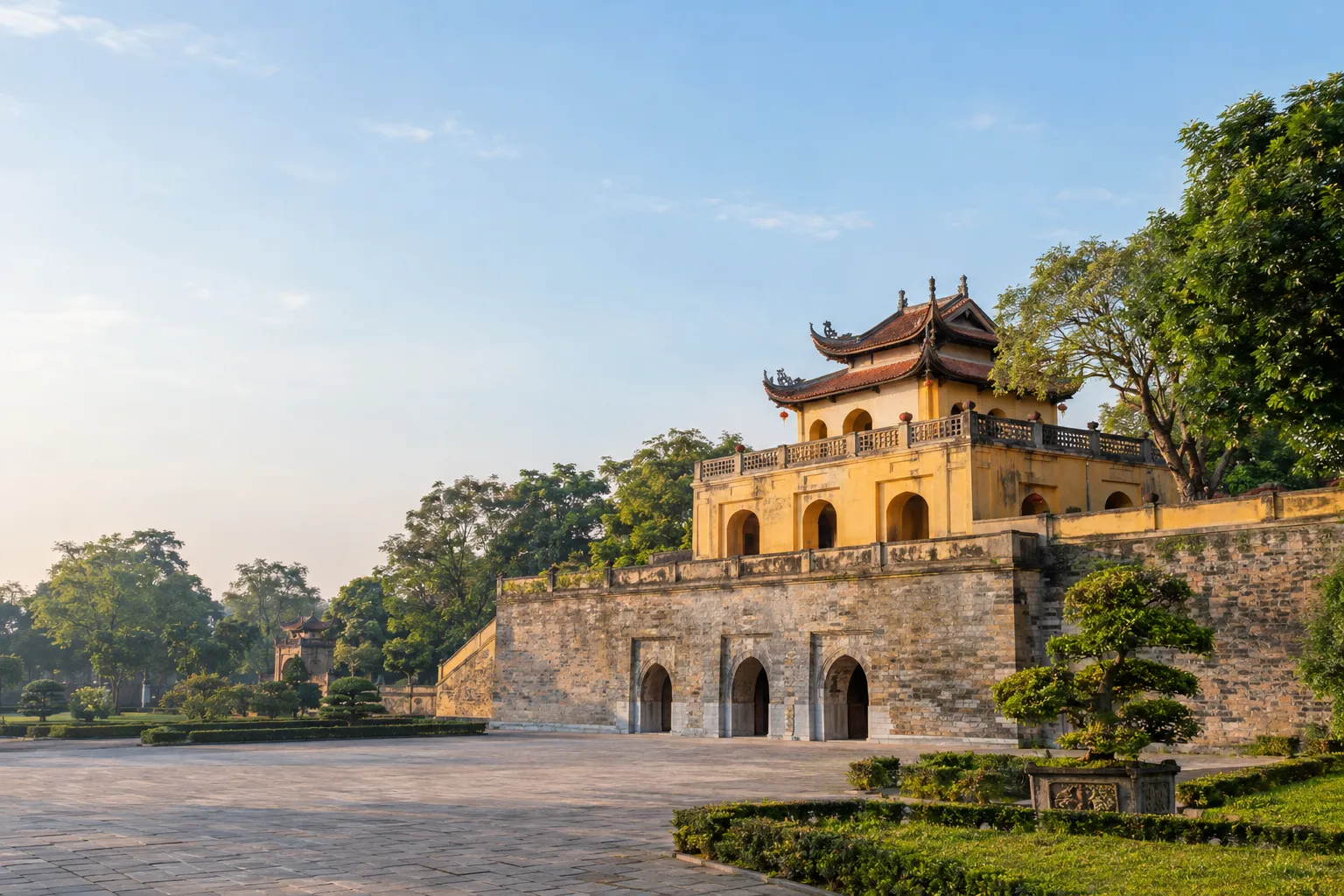
Hanoi’s architecture is not a single style but a conversation among institutions, eras and materials. From excavated imperial foundations to a scholarly pavilion and a museum building shaped by French and vernacular values, these sites reward visitors who take time to look closely.
Start with three distinct perspectives: imperial archaeology at Thăng Long, scholarly design at the Temple of Literature and the former Louis Finot Museum’s blend of French and vernacular values.
At Khuê Văn Các, notice the square lower level, circular upper windows and two-tier roof described by the official site; it was commissioned in 1805 and became a Hanoi symbol in 2012.
Khuê Văn Các was commissioned
1805
Khuê Văn Các became a symbol of Hanoi
2012
Cultural layers described in the citadel’s 2025 excavation reporting
Six
Hanoi locations identified by the Vietnam National Museum of History
Two
Orientation
Begin with layers, not labels
Hanoi’s architectural character is best understood through comparison: the physical traces of imperial authority, the composed spaces of scholarship and a museum building shaped by the meeting of French and vernacular values.
A guide to exploring architecture and design in Hanoi
Hanoi rewards attention to transitions. Rather than presenting one uniform architectural style, the city offers places where different institutions, periods and ideas about public life can be read side by side. The most useful approach is not to search for a single visual definition of the city, but to ask what each building was made to do, how its spaces organise movement, and what remains visible today.
Three sites offer a particularly grounded introduction: the Imperial Citadel of Thăng Long, the Temple of Literature and the Vietnam National Museum of History. They represent distinct ways of understanding architecture: as the setting of political ceremony, as an expression of learning and institutional order, and as a building whose own design can reveal cultural exchange. This is an invitation to look closely, not a claim that these places form a timed route or that every historical layer is fully visible.
The pleasure of reading a city in layers
At the citadel, archaeological evidence complicates the idea of a single preserved monument. At Văn Miếu – Quốc Tử Giám, a named pavilion makes symbolic form especially legible. At the museum, the architecture of the former Louis Finot Museum adds a further perspective: a building described by a museum-hosted paper as combining French and vernacular architectural values. Together, these places encourage a visitor to consider both what survives and what a site’s design communicates.
A rewarding visit is therefore measured less by the number of landmarks covered than by the quality of attention given to them. Look at thresholds, axial approaches, courtyards, roof profiles, stonework and the relationship between a structure and its setting. Read official site material alongside the physical evidence, especially where archaeological remains are involved. This makes the city’s architectural story more precise and avoids treating reconstruction, surviving fabric and excavated foundations as interchangeable.
Imperial history
Where the imperial city remains visible
At the Imperial Citadel of Thăng Long, the relationship between architecture and archaeology is central. What survives invites close reading, while excavation reveals a deeper sequence beneath the present-day site.
Thăng Long Citadel: architecture as archaeological evidence
The Imperial Citadel of Thăng Long is a strong place to begin because its architecture is inseparable from its long history as a centre of power. The official site presents Kinh Thiên Palace as the former ceremonial centre of the imperial complex. Today, the palace is not encountered as a complete reconstructed building: the surviving foundation and carved stone dragons provide concrete points from which to imagine its role and scale without overstating what remains.
That distinction matters. A foundation is evidence, not a full elevation; an archaeological site asks visitors to interpret absences as well as objects. Stonework can communicate hierarchy and ceremony, while the ground plan and surrounding remains help suggest how an architectural complex was organised. The visitor’s task is partly visual and partly analytical: separate what can be seen directly from what the historical account helps explain.
Look closely at the surviving palace foundation and carved stone dragons identified by the official site.
Treat archaeological remains as evidence of earlier structures, rather than as a complete palace standing today.
Use the site’s interpretation to understand how political and ceremonial functions shaped the complex.
What the excavated layers can tell you
The official site’s 2025 excavation reporting describes six cultural layers, extending from the 7th–10th centuries through the modern period, and reports newly identified palace foundations. This makes the citadel especially compelling for anyone interested in how a city’s built history can accumulate in the ground. The layers are not simply a sequence of styles displayed in a row; they are a record recovered through research and excavation, with each discovery contributing to a more complex account of the site.
The experience is different from looking at a restored façade. Here, architectural understanding depends on context: where a foundation lies, what layer it belongs to, and how experts interpret its relation to other remains. The official site is the appropriate place to consult for current visitor arrangements and interpretation. Do not assume that every discovery is exposed to view or that a reported excavation area is necessarily accessible to visitors.
Learning and form
The architecture of scholarship
The Temple of Literature offers a close study of symbolic architecture, with Khuê Văn Các providing a particularly legible example of proportion, opening and roof form.
Khuê Văn Các: geometry, roofline and civic meaning
Văn Miếu – Quốc Tử Giám offers a different architectural register. The official site describes Khuê Văn Các as a pavilion commissioned in 1805, with a square lower level, circular upper windows and a two-tier roof. These elements make the structure an unusually clear lesson in the way geometry, elevation and silhouette can give a building an identity beyond its immediate function.
Its proportions reward a measured look. Notice the contrast between the grounded lower level and the lighter upper pavilion, then consider how the circular openings alter the square form. The roof is not a detachable ornament: its tiers shape the outline that visitors recognise and help distinguish the pavilion within the larger scholarly complex. The official source also notes that Khuê Văn Các became a symbol of Hanoi in 2012, linking its architectural form to the city’s civic identity.
Compare the square lower level with the circular openings above.
Observe how the two-tier roof defines the pavilion’s silhouette.
Consider how a structure within an educational complex can also become a wider civic symbol.
Reading the scholarly complex as a whole
The site’s broader value lies in the relationship between individual structures and an institution devoted to learning. Architecture here can be read as an arrangement of spaces that gives order to movement and attention. Rather than isolating a single photogenic view, observe how the pavilion sits within the sequence of the complex and how thresholds and open areas guide the visitor’s perception.
The official visitor pages provide the reliable basis for planning a visit, including information about the site and its areas. Because visitor arrangements may change, check the current official information before travelling. Allow yourself time to look at the composition from more than one position, while respecting any directions or restricted areas on site. A careful visit is more useful than trying to infer the entire history of the institution from one architectural feature.
Cultural exchange
A museum with an architectural story
The former Louis Finot Museum offers a way to examine how architectural traditions can meet in a public building, while its present museum role connects the structure to wider narratives of Vietnamese history.
The former Louis Finot Museum: a meeting of design traditions
The Vietnam National Museum of History adds a different perspective: here the building itself is part of the subject. The museum’s official site identifies two Hanoi locations and presents exhibitions on Vietnamese history. A museum-hosted paper on the former Louis Finot Museum characterises its architecture as a blend of French and vernacular values. That description is a useful starting point for looking at the building as more than a container for its collections.
Approach the exterior with questions rather than a checklist of stylistic labels. Which features seem to express a formal institutional language? Where might local responses or vernacular references be discerned? The source establishes a combination of values, but it does not require a visitor to reduce the building to a simple formula. The more thoughtful reading is that architectural identity can emerge through adaptation, interpretation and the circumstances in which a public institution is built.
Consider how the museum building communicates its public and institutional role.
Use the museum-hosted description of French and vernacular values as a prompt for observation, not a complete stylistic verdict.
Keep the building’s architecture distinct from the historical objects displayed inside.
Looking at the museum as both building and institution
This distinction between container and collection is useful throughout Hanoi. A museum’s displays tell one story; its building may tell another about design, cultural exchange and public life. Where the two meet, pause to consider how the architecture frames the visitor’s experience: how one enters, how rooms are sequenced and how the building presents itself to the city.
The museum’s official website is the source to consult for its locations, exhibitions and current visitor details. The available research identifies two locations but does not establish a convenient sequence between them, nor does it confirm current opening hours. Check the latest official information before planning. If your interest is architectural, make time to observe the exterior and the surrounding setting as well as the displays, while following the museum’s photography and visitor rules.
On-site observation
How to look, compare and record
Architectural sightseeing becomes richer when observation is structured. A few consistent questions help visitors compare sites without flattening their differences.
A practical method for looking closely
A thoughtful architectural visit depends on choosing a question before choosing a camera angle. At Thăng Long, ask how archaeology changes what it means to encounter a palace. At Văn Miếu – Quốc Tử Giám, consider how geometry and a roofline can turn a pavilion into a recognisable symbol. At the former Louis Finot Museum, look for the relationship between institutional form and the combination of French and vernacular values described by the museum-hosted paper.
These questions create a coherent framework without implying that the sites belong to one uninterrupted architectural style. They also help a visitor distinguish observation from interpretation. A visible feature can be described directly; an account of its purpose or historical meaning should be grounded in reliable site interpretation. When evidence is incomplete, leave the question open rather than filling the gap with an attractive but unsupported story.
Describe what is physically visible before deciding what it means.
Compare how each site organises approach, enclosure and movement.
Separate surviving structures, archaeological evidence and interpretive reconstruction.
Use official interpretation to check historical claims.
Photography, patience and respect for the site
Photography can support this approach when it records relationships rather than isolated details. Frame a pavilion with enough of its setting to show how it belongs to a larger complex. At an archaeological site, include context that helps distinguish foundation traces from standing architecture. At the museum, photograph the building as a public structure rather than only as a decorative façade, subject to current visitor rules.
Light, weather and crowds affect what can be seen, but there is no need to pursue a perfect image. A short written note about a threshold, a roof profile or a change in level may preserve more useful insight than a sequence of hurried photographs. Give the place room to be understood at its own pace, and avoid touching or crossing barriers around fragile fabric and archaeological remains.
Before you go
Make a considered visit
A useful plan is informed by current official details and leaves room for the different pace each site demands. Treat this as a framework for choosing priorities, not a guaranteed itinerary.
Plan around the places, not an assumed timetable
These sites can form the basis of an architectural day or a broader cultural visit, but the available evidence does not verify transit times, a fixed route, guided-tour availability or a common ticketing arrangement. Plan each stop independently. Confirm the current opening arrangements and visitor guidance on the official website for the relevant site, and allow flexibility for the time needed to read displays or examine architectural details.
Start with the subject that matters most to you. If archaeology is the priority, give the citadel enough time for interpretation as well as viewing. If you are drawn to symbolic form, focus on Khuê Văn Các and its setting within the Temple of Literature. If the museum building is your principal interest, check which location and current exhibition information apply before setting out. These choices are more dependable than assuming an itinerary will work to a particular timetable.
Check official visitor information for each venue close to the date of your visit.
Confirm which museum location you intend to visit and what current displays are listed.
Do not assume that site hours, access arrangements or temporary exhibitions remain unchanged.
Build in time to read interpretation and observe the setting, rather than treating each stop as a quick photograph.
Practical preparation and responsible visiting
Hanoi’s traffic and the distance between venues may shape how much can comfortably be seen in one outing, but the sources used here do not establish specific journey times or transport recommendations. Choose a sequence that suits your starting point and available time, and verify practical arrangements independently. If you are organising transport for a wider trip, London Direct Chauffeurs Ltd provides pre-booked transport across the United Kingdom; the confirmed information does not establish a Hanoi-based service, so no local transport recommendation is made here.
At each site, follow posted guidance and respect conservation boundaries. Archaeological places and historic buildings are not simply backdrops: their material condition depends on careful use. Check photography rules where relevant, avoid touching historic surfaces, and follow staff instructions. A flexible plan leaves room for an unexpected detail, a temporary closure or the simple need to pause and look more carefully.
Perspective
Let the city’s layers remain distinct
The most satisfying way to explore Hanoi’s architecture is to compare distinct sites while remaining attentive to the evidence each one actually presents.
A city best understood through comparison
The architectural appeal of Hanoi is not a puzzle with one definitive answer. It is an invitation to compare how built form records authority, learning and cultural exchange. Thăng Long’s foundations and excavated layers make the past materially present while also reminding visitors how much must be interpreted. Khuê Văn Các shows how a composed form can carry institutional and civic meaning. The former Louis Finot Museum makes the building itself part of a conversation about French and vernacular values.
Together, these places offer a thoughtful introduction to the city’s design history without pretending to represent every period, neighbourhood or building type. Their differences are the point. Look closely, consult official interpretation, and let each site set its own terms. The result is a more rewarding way to explore Hanoi: attentive to what is visible, alert to what remains uncertain, and interested in architecture as a living record rather than a catalogue of façades.
A considered conclusion
Before visiting, check official site information for opening arrangements, location-specific details and any current restrictions. Keep plans adaptable and make space for observation. The strongest architectural impressions often come from small decisions of form and setting: a roof tier, an axis, an opening, a foundation line, or the way a building frames a public institution.
Questions answered
Hanoi architecture guide FAQs
What are good places to explore architecture in Hanoi?
The Imperial Citadel of Thăng Long, Văn Miếu – Quốc Tử Giám and the former Louis Finot Museum at the Vietnam National Museum of History offer distinct architectural perspectives supported by official site information.
What is distinctive about Khuê Văn Các?
The official Temple of Literature site describes it as commissioned in 1805, with a square lower level, circular upper windows and a two-tier roof. The site says it became a symbol of Hanoi in 2012.
Can visitors see Kinh Thiên Palace as a complete building?
The official citadel site describes the surviving palace foundation and carved stone dragons. The palace should not be described as a complete reconstructed building that visitors can see today.
Should I confirm opening details before visiting?
Yes. Check the current official visitor information for each venue before setting out, as opening arrangements and access details may change.